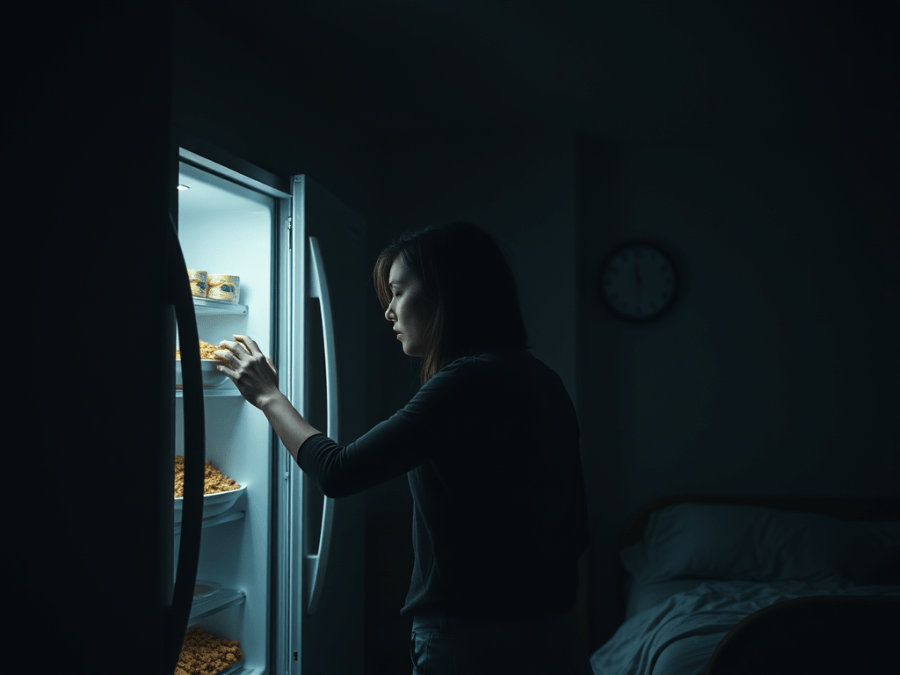
Night Eating Syndrome (NES) is one of those conditions that many patients, and even some clinicians, overlook. NES is a recognizable eating disorder where the timing of food intake shifts into the evening and nighttime hours, distinct from occasional snacking after dinner. Patients often feel embarrassed and dismiss it as a bad habit. It has real consequences for weight, sleep, and overall health.
The diagnosis of NES is based on established criteria. To meet the definition, at least 25 percent of daily food intake occurs after the evening meal or there are at least two episodes of nocturnal eating per week. These episodes are not explained by social or cultural norms. People with NES are aware of what they are eating at night, unlike sleep-related eating disorders where the behavior may happen without recall. The condition also needs to cause significant distress or impairment in functioning (Allison & Tarves, 2011).
In practice, this can look two different ways. Some patients skip breakfast, eat a small lunch, and end up consuming half their calories after dinner. Others wake almost every night around 1 or 2 a.m., head to the kitchen, and eat before they can fall back asleep. Over time, the pattern disrupts sleep and drives weight gain.
NES also overlaps with mood and sleep disorders. Patients often report insomnia, depression, or evening stress. Eating becomes a way to cope with anxiety or to induce sleep. That’s why treatment has to be more than calorie restriction. Cognitive behavioral therapy focused on both eating and sleep habits has shown promise, and selective serotonin reuptake inhibitors (SSRIs) have been helpful in some patients (Allison & Tarves, 2011). I prefer CBT-I, but in practice medications often end up being what gets prescribed. I don’t treat night eating syndrome myself. I screen for it before prescribing weight loss medications, then refer out.
The tie between NES and obesity is important. McCuen-Wurst and colleagues (2018) have shown that NES is associated with higher rates of metabolic problems such as type 2 diabetes and hypertension. Timing matters. Eating late into the night throws off circadian rhythms and glucose metabolism, so the impact is greater than just extra calories.
On a video visit, NES surfaces only if you ask about it directly. Within the past six months, one patient told me, “I can’t sleep unless I eat something at midnight.” That single line was the diagnosis: Night Eating Syndrome. We had her follow up with behavioral health.
Treatment is best when it’s individualized. Weight loss alone won’t fix NES if the underlying behaviors and triggers aren’t addressed. Collaboration between primary care, psychiatry, nutrition, and sleep medicine can make a real difference. For colleagues, the key is asking when patients eat as closely as how much. For patients, understanding that this is a recognized condition with treatment options can take away some of the shame and open the door to better care.
Scott Rennie, D.O.
Board Certified in Obesity Medicine and Family Medicine
This blog is for educational purposes only and does not constitute individual medical advice. Always consult your own physician before making changes to your health, medications, or treatment plan.
References:
Allison KC, Tarves EP. Treatment of night eating syndrome. Psychiatr Clin North Am. 2011;34(4):785-796. doi:10.1016/j.psc.2011.08.002
McCuen-Wurst C, Ruggieri M, Allison KC. Disordered eating and obesity: associations between binge-eating disorder, night-eating syndrome, and weight-related comorbidities. Ann N Y Acad Sci. 2018 Jan;1411(1):96-105. doi: 10.1111/nyas.13467. Epub 2017 Oct 16. PMID: 29044551; PMCID: PMC5788730
 Doctor Rennie's Blog