
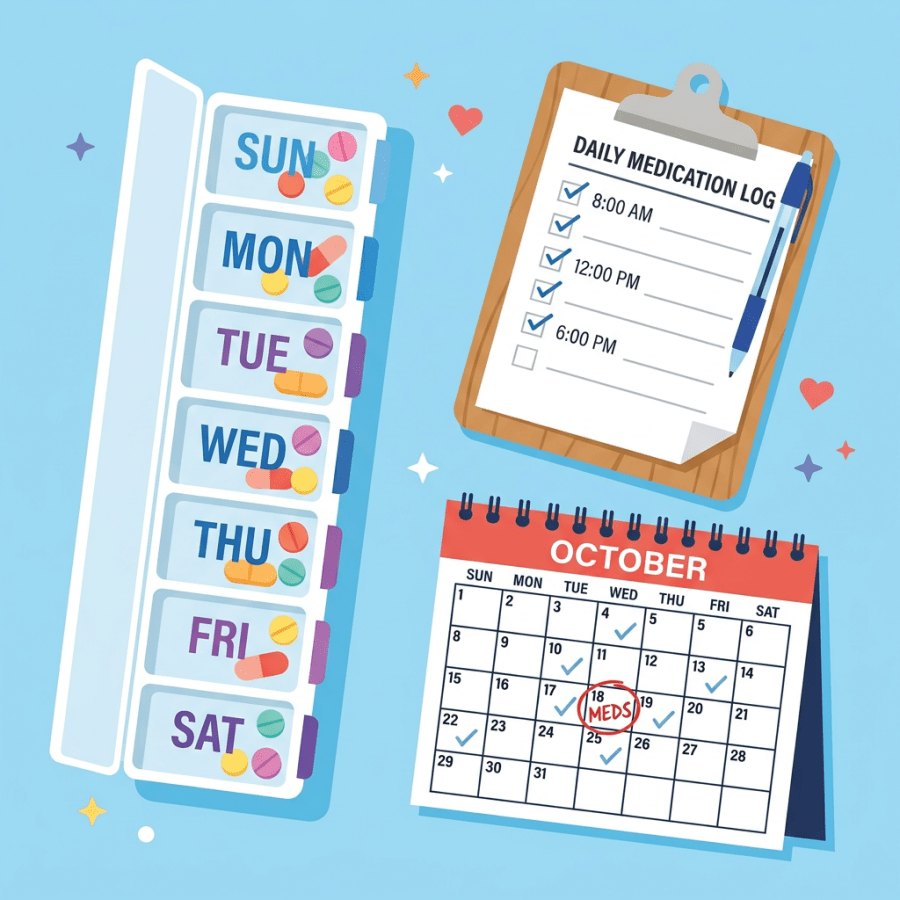

Weekly pill organizer, daily medication log with times checked, calendar with medication reminders

Tips to Manage and Organize Your Elderly Parent’s Medications

shutterstock_138204188

Many of my patients, and many of the families I work with, face the same challenge. Their parents are taking multiple medications, sometimes several times a day, and it’s hard to keep everything straight. As memory declines with age, the details of what to take, when to take it, and why it matters can easily get lost. The problem is that missing doses or mixing up prescriptions can quickly affect health.

I’ve found that patients do better when they understand why they’re taking each medication. A simple note like “blood pressure” or “cholesterol” written next to the name helps. I often hand out an updated medication list at every visit. It’s printed in a large, easy-to-read font so it doesn’t get overlooked. Some people keep that list on the fridge or next to their pill bottles so they can check it quickly. Others like to carry it on a USB drive or keep it stored securely online, so it’s available if they land in another clinic or hospital. The key is making sure the list stays current. Whenever a prescription changes, I encourage families to replace the old list immediately (Centers for Disease Control and Prevention, 2023).

Where medications are stored makes a difference too. If bottles are tucked away in a cabinet, they’re easier to forget. Putting them near the coffee maker, a water dispenser, or a bathroom sink works better. Those spots become natural reminders because the person passes them throughout the day.

When I visit a patient at home, I try to look at the actual bottles. Comparing what’s on the label with what’s on the chart can prevent mistakes, like taking an outdated prescription. If a refill is almost due, it’s easier to take care of it right then than to wait until the patient runs out.

Simple tools can also make a big impact. Pill boxes are inexpensive and work well for organizing doses by day or time. Even basic versions you can buy at the pharmacy help patients and caregivers see at a glance whether a dose has been taken. More advanced boxes come with reminders built in, though those cost more.

Technology is playing a growing role in this space. Some prescription bottles now come with reminder caps that glow, beep, or even send a text message when it’s time to take the next dose. Vitality’s GlowCaps are one example that combine light and sound alerts with electronic reminders (Vitality, 2024). For patients who already use smartphones, setting a daily alarm or calendar alert works just as well.

There are also mobile apps designed specifically for tracking medications. Options like iPills, Pillbox, Pillboxer, and The Pill Phone help patients and caregivers schedule, track, and confirm doses (National Institutes of Health, 2022). For tech-savvy patients, these can reduce the burden of trying to remember everything on their own.

None of these approaches are complicated, but they do take a little extra time and attention. Whether it’s keeping an updated list, moving the bottles where they’re easier to see, or using a pill box or phone alarm, the goal is the same. Patients who remember their medications stay healthier, and caregivers have one less thing to worry about.

This article is for information only and is not medical advice for any individual. Please talk with your medical provider about any specific questions.

Related Reading

Can Doctors Help Seniors Live Independently Longer?

End-of-Life Care: How to Talk About Your Own Wishes

Allergic Antibiotic Drug Reactions – Am I Truly Allergic to Penicillin?

Scott Rennie, D.O.
Board Certified in Obesity Medicine and Family Medicine

This blog is for educational purposes only and does not constitute individual medical advice. Always consult your own physician before making changes to your health, medications, or treatment plan.


Two steaming cups of tea on wooden coasters on a windowsill with a garden view

End-of-Life Care: How to Talk About Your Own Wishes

shutterstock_57012596

Last week I sat with a patient who wanted to talk about end of life care. They weren’t sure how to bring it up with their family. That’s something I see often. These conversations are difficult, and many families don’t know what their loved one would want until a crisis forces the issue.

In medicine, we routinely ask elderly or terminally ill patients about their preferences if their heart were to stop or they couldn’t breathe. For younger patients the assumption is clear. Everything will be done. That usually means putting in a breathing tube, doing CPR, and starting medications through an IV. But for someone at the end of their life, those same measures may not be what they want. Some even feel those interventions would add suffering rather than comfort. What many people don’t realize is that unless there’s a written order stating otherwise, hospitals are required to attempt resuscitation (American Hospital Association, 2008).

Families often find it easier to honor those wishes if they’ve already been discussed. I’ve seen the opposite too. Relatives gathered at the bedside, each with a different opinion, unsure of what the patient would have chosen. When these conversations happen in advance, patients get peace of mind and families can act with confidence.

Many hospitals offer worksheets to help guide these decisions. They can be filled out ahead of time and kept in an accessible place, like on the refrigerator. That way, if emergency responders arrive, the document is easy to find. State-specific advance directives were available as early as 2011 through the National Hospice and Palliative Care Organization, and those forms allowed patients to record their choices and designate someone to speak for them if they could not (NHPCO, 2011).

These conversations are never simple, but they make a difference. They help ensure care matches what the patient truly wants and reduce the stress on families in the middle of a crisis.

Related Reading

Can Doctors Help Seniors Live Independently Longer?

Tips to Manage and Organize Your Elderly Parent’s Medications

Emergency Room vs Urgent Care: Which Should You Choose?

Scott Rennie, D.O.
Board Certified in Obesity Medicine and Family Medicine

This blog is for educational purposes only and does not constitute individual medical advice. Always consult your own physician before making changes to your health, medications, or treatment plan.



Sources (pre-2011):

  • American Hospital Association. “Patient Self-Determination Act and Advance Directives.” AHA, 2008.

  • National Hospice and Palliative Care Organization. “Advance Directives.” NHPCO, 2011.

Can Doctors Help Seniors Live Independently Longer?

One of the main goals in my practice has always been to help older patients stay in their own homes for as long as possible. People do better when they remain in familiar surroundings and in the communities they know. Families often ask me how they can let their loved one hold on to independence while still getting the care they need.

There are real challenges. Memory problems can make it hard to keep track of medications. Mobility issues after something like a hip fracture can limit daily activity. Chronic conditions such as heart failure, uncontrolled diabetes, or severe COPD can complicate matters further. And many times, family members live hours away or even in another state, which makes caregiving even harder.

I’ve found that having a primary care provider who coordinates all aspects of medical care is one of the most important steps. When patients are dealing with multiple specialists, prescriptions, and appointments, it’s easy for things to get confusing. My role often becomes helping them navigate the system and making sure nothing slips through the cracks.

Simple tools can help. Some patients do well with prescription bottles that have timer caps, which remind them when it’s time for the next dose. Others like having a printed summary of their medications and visits, since it’s easy to forget details once they leave the office. Families often appreciate being kept in the loop about any changes in treatment, especially if they aren’t nearby.

Technology was already making inroads by 2011. I had patients who carried their medical records on a small device attached to their key ring so that if they ended up in an emergency room, their history could be accessed quickly (Agency for Healthcare Research and Quality, 2009). Even basic tools like calendars, written reminders, and updated medication lists can reduce errors and stress.

Home visits give another layer of insight. Seeing the living space allows me to suggest equipment that supports independence. A shower chair or grab bars in the bathroom can prevent falls. A raised toilet seat or a bed rail can make daily tasks safer. Some patients benefit from a hospital-type bed that can be adjusted for breathing or comfort, or from an over-bed table to help with meals and reading. These small changes can make a big difference in whether someone can stay at home comfortably.

I’ve also seen how involving patients in decisions about their care improves outcomes. When they feel ownership, whether it’s deciding which pill organizer to use or whether to accept in-home care, they’re more likely to follow through. At the same time, we have to be cautious about medications that increase fall risk, such as sedatives, and review them regularly (Institute of Medicine, 2006).

Helping older adults remain independent at home is one of the most rewarding parts of my work. It’s about supporting both the patient and their family, finding the right balance of medical care, safety, and autonomy.

Related Reading

End-of-Life Care: How to Talk About Your Own Wishes

Tips to Manage and Organize Your Elderly Parent’s Medications

Direct Primary Care: Access Problems in Today’s Clinics

Scott Rennie, D.O.
Board Certified in Obesity Medicine and Family Medicine

This blog is for educational purposes only and does not constitute individual medical advice. Always consult your own physician before making changes to your health, medications, or treatment plan.


Sources:

  • Agency for Healthcare Research and Quality. “Personal Health Records: Improving Patient Safety.” AHRQ, 2009.

  • Institute of Medicine. “Preventing Medication Errors.” National Academies Press, 2006.