

Binge Eating Disorder Signs and Treatment in Adults and Kids

Binge Eating Disorder, or BED, is one of the eating disorders I screen for most often in practice. Clinicians define it as repeated episodes of eating a large amount of food in a short period of time while feeling a loss of control during the episode. BED involves episodes that feel compulsive: the person cannot stop eating even when full or uncomfortable. This goes well beyond a second helping at dinner or an indulgent dessert.

The diagnostic criteria for BED require both that large amounts of food are consumed in a discrete time frame and that there is a sense of loss of control while eating. The episodes are also linked to behaviors such as eating more rapidly than normal, eating until uncomfortably full, eating when not hungry, eating alone because of embarrassment, and feeling disgusted or guilty afterward. At least three of those behaviors must be present. The episodes need to occur at least once a week for three months, cause distress, and they are not followed by purging behaviors like in bulimia.

Here’s a hypothetical that illustrates the pattern: someone sits down in the evening and works through an entire pizza and a half-gallon of ice cream in under two hours, not from hunger but because they can’t stop. They feel physically ill afterward. Ashamed, too. The cycle repeats weekly or more often. I’ve seen a real version of this on video visits. One of my patients was managing things with intermittent fasting, and it worked in the sense that the scale moved, but every time the eating window opened back up, they took in way more calories than they needed. The fast itself was setting up the binge.

Children complicate this picture. For kids under 12, researchers have proposed a related diagnosis called Loss of Control Eating Disorder, or LOC-ED (Tanofsky-Kraff et al., 2008). The issue is that children may not consume amounts of food that adults would consider objectively large, but they still experience the same loss of control. In this group, the definition focuses on the subjective sense of being unable to stop eating. The proposed criteria mirror those of BED but apply specifically to children younger than 12. The episodes still need to happen at least once a week for three months and cause distress.

Picture a hypothetical case in pediatrics: a 10-year-old who sneaks into the kitchen at night, eats snack foods quickly, and can’t stop once started. The amount might look modest by adult standards. For a child, it’s significant. What matters is the loss of control, not the portion size. Wrappers hidden in the trash. A refusal to eat breakfast the next morning. Those are often the only clues a parent gets.

Treatment is available for both BED and LOC-ED. For adults with BED, the most evidence supports cognitive behavioral therapy, which helps patients identify triggers, restructure eating patterns, and address guilt and shame. Interpersonal therapy has also been shown to help, especially when social stress is a driver. Some patients benefit from medications. SSRIs have modest benefit for binge frequency, and lisdexamfetamine is the only medication currently approved by the FDA for BED in adults. Nutritional counseling and structured meal planning are usually part of the approach.

I should be direct about where I actually fit into this picture. I don’t manage BED treatment myself. Real treatment leans heavily on behavioral health, and in my current telemedicine positions I don’t have the coordination with a therapist or eating-disorder specialist that this really requires. What I do is screen for it on video visits: ask the direct questions, name what I’m seeing, and refer out from there.

For children with LOC-ED, treatment recommendations are less formalized since the diagnosis itself is still considered research-based. The focus is often on family-based behavioral therapy, involving parents in setting up structured eating schedules and reducing situations where loss of control is most likely to occur. Addressing mood or anxiety symptoms is important, since these are often linked to eating episodes. Nutrition support is also key, both for the child and for parents trying to guide food choices. Medications are not first-line in children.

Recognizing BED or LOC-ED is important because both conditions are linked to higher rates of obesity, depression, and medical complications if untreated. Many people don’t come forward because of shame or because they don’t realize their pattern is a diagnosable disorder. Asking direct questions about eating behaviors, especially around loss of control, can uncover these conditions and open the door to treatment.

If this description fits you or someone you know, talk with a healthcare provider. Early recognition, especially in children, can change the trajectory and reduce the risk of chronic problems.

Scott Rennie, D.O.
Board Certified in Obesity Medicine and Family Medicine

This blog is for educational purposes only and does not constitute individual medical advice. Always consult your own physician before making changes to your health, medications, or treatment plan.

References:

Allison KC, Tarves EP. Treatment of night eating syndrome. Psychiatr Clin North Am. 2011;34(4):785-796. doi:10.1016/j.psc.2011.08.002

McCuen-Wurst C, Ruggieri M, Allison KC. Disordered eating and obesity: associations between binge-eating disorder, night-eating syndrome, and weight-related comorbidities. Ann N Y Acad Sci. 2018 Jan;1411(1):96-105. doi: 10.1111/nyas.13467. PMID: 29044551; PMCID: PMC5788730

Tanofsky-Kraff M, Marcus MD, Yanovski SZ, Yanovski JA. Loss of control eating disorder in children age 12 years and younger: proposed research criteria. Eat Behav. 2008;9(3):360-365. doi:10.1016/j.eatbeh.2008.03.001

Why Do I Eat at Night? Night Eating Syndrome Explained

Night Eating Syndrome (NES) is one of those conditions that many patients, and even some clinicians, overlook. NES is a recognizable eating disorder where the timing of food intake shifts into the evening and nighttime hours, distinct from occasional snacking after dinner. Patients often feel embarrassed and dismiss it as a bad habit. It has real consequences for weight, sleep, and overall health.

The diagnosis of NES is based on established criteria. To meet the definition, at least 25 percent of daily food intake occurs after the evening meal or there are at least two episodes of nocturnal eating per week. These episodes are not explained by social or cultural norms. People with NES are aware of what they are eating at night, unlike sleep-related eating disorders where the behavior may happen without recall. The condition also needs to cause significant distress or impairment in functioning (Allison & Tarves, 2011).

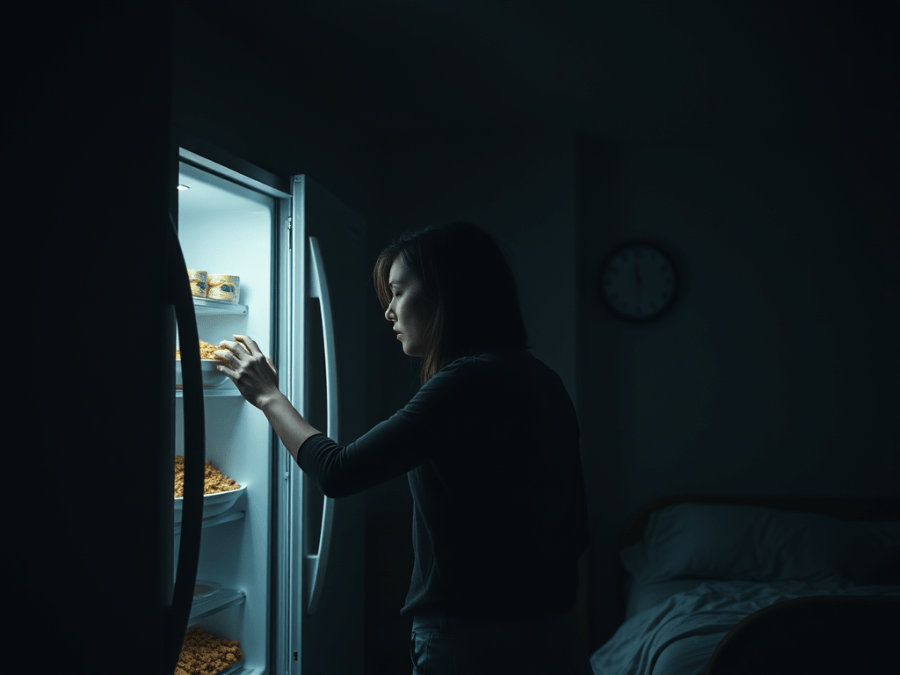
In practice, this can look two different ways. Some patients skip breakfast, eat a small lunch, and end up consuming half their calories after dinner. Others wake almost every night around 1 or 2 a.m., head to the kitchen, and eat before they can fall back asleep. Over time, the pattern disrupts sleep and drives weight gain.

NES also overlaps with mood and sleep disorders. Patients often report insomnia, depression, or evening stress. Eating becomes a way to cope with anxiety or to induce sleep. That’s why treatment has to be more than calorie restriction. Cognitive behavioral therapy focused on both eating and sleep habits has shown promise, and selective serotonin reuptake inhibitors (SSRIs) have been helpful in some patients (Allison & Tarves, 2011). I prefer CBT-I, but in practice medications often end up being what gets prescribed. I don’t treat night eating syndrome myself. I screen for it before prescribing weight loss medications, then refer out.

The tie between NES and obesity is important. McCuen-Wurst and colleagues (2018) have shown that NES is associated with higher rates of metabolic problems such as type 2 diabetes and hypertension. Timing matters. Eating late into the night throws off circadian rhythms and glucose metabolism, so the impact is greater than just extra calories.

On a video visit, NES surfaces only if you ask about it directly. Within the past six months, one patient told me, “I can’t sleep unless I eat something at midnight.” That single line was the diagnosis: Night Eating Syndrome. We had her follow up with behavioral health.

Treatment is best when it’s individualized. Weight loss alone won’t fix NES if the underlying behaviors and triggers aren’t addressed. Collaboration between primary care, psychiatry, nutrition, and sleep medicine can make a real difference. For colleagues, the key is asking when patients eat as closely as how much. For patients, understanding that this is a recognized condition with treatment options can take away some of the shame and open the door to better care.

Scott Rennie, D.O.
Board Certified in Obesity Medicine and Family Medicine

This blog is for educational purposes only and does not constitute individual medical advice. Always consult your own physician before making changes to your health, medications, or treatment plan.

References:

Allison KC, Tarves EP. Treatment of night eating syndrome. Psychiatr Clin North Am. 2011;34(4):785-796. doi:10.1016/j.psc.2011.08.002

McCuen-Wurst C, Ruggieri M, Allison KC. Disordered eating and obesity: associations between binge-eating disorder, night-eating syndrome, and weight-related comorbidities. Ann N Y Acad Sci. 2018 Jan;1411(1):96-105. doi: 10.1111/nyas.13467. Epub 2017 Oct 16. PMID: 29044551; PMCID: PMC5788730

Woman sitting in an armchair beside a rain-speckled window

Anxiety: Practical Tips and What Can Actually Help

shutterstock_86293354Today a patient came in because she’s been feeling anxious because she’s had some heart palpitations.  She’s seen a cardiologist (heart specialist) and learned that the abnormal heart rhythm is intermittent atrial fibrillation (a usually non-dangerous rhythm) that has likely been brought on by the increased stress and lack of sleep lately.  When she gets the heart palpitations, she becomes more anxious, and the more anxiety that she experiences,  the more heart palpitations she has.  To her, it feels like an endless cycle that will never end. This patient’s anxiety is understandable.  We all experience stressful or potentially anxiety provoking details that occur in our lives.  How we deal with these thoughts and events is critically important because it often determines how we function from day to day. Feeling anxious can be a normal response to a stressful situation.  The adrenaline rush after we learn that a bear is in our campsite might help us escape the dangerous situation.  Feeling anxious for most of the day for long periods of time however is not normal. Symptoms:  Excessive worry or feelings of dread or being “on edge” may contribute to daily fatigue, and muscle tension.  Other common symptoms may include headaches, hives, heart burn, constipation, diarrhea, abdominal pain, chest tightness, difficulty sleeping, memory problems and an increase or decrease in appetite.  Sometimes a patient might have depression along with anxiety. Often patients come in to talk with me about treatment for their anxiety with medications.  I understand that feeling anxious is not particularly desirable, however in many circumstances, it’s normal.  Treating the anxiety is often most effective by addressing the anxiety provoking situation rather than masking the symptoms with medication.  Once the medications wear off, the anxiety returns and the cycle repeats itself. I think it’s important to distinguish the difference between anxiety and an anxiety disorder.  People who have “normal” anxiety may have worries from time to time, but these feelings do not interfere with daily life.  An example might be a parent worried about their child who is late coming home from a date.  I’m sure you can think of many other examples.  People with an anxiety disorder are often worried or anxious about a number of events or activities and these worries are out of proportion to the situation.  A parent might worry excessively about their child’s safety even when the child is at home with the family.  An anxiety disorder can make routine activities difficult to complete.  There are certain criteria that need to be met in order to make a diagnosis of an anxiety disorder and it’s my opinion that only a qualified health mental professional with training in anxiety disorders such a psychologist should make this diagnosis. Treatment:  Usually we tailor the treatment to the individual patient and what is causing the anxiety.  If the anxiety is caused by a certain life event, then learning how to address the feelings and concerns related to the event is often the most helpful way to decrease the anxiety.  Individuals who suffer from an anxiety disorder often require more treatment than those who have anxiety from stressful life events.  Some possible treatments for anxiety might include: 1)   Cognitive Behavioral Therapy (CBT): CBT focuses on the person’s behavior and patterns of thinking.  The therapist helps teach you how your thoughts contribute to your anxiety and how to decrease these negative or unpleasant thoughts when they occur. 2)   Eye Movement desensitization and reprocessing (EMDR): A particularly effective technique being used by psychologists who have had specialized training.  One of the procedural elements is “dual stimulation” using either bilateral eye movements, tones or taps. During the reprocessing phases the patient attends momentarily to past memories, present triggers, or anticipated future experiences while simultaneously focusing on a set of external stimulus. During that time, clients generally experience the emergence of insight, changes in memories, or new associations. The clinician assists the client to focus on appropriate material before initiation of each subsequent set. 3)   Medications: If medication is used to treat anxiety, you will need to see a primary care provider or psychiatrist.  If a patient has an anxiety disorder however, my opinion is that the patient should also be treated by a mental health provider such as a psychologist and/or psychiatrist.  Medications used to treat anxiety may include:
  1. Antidepressant medications such as SSRI or SNRI.  Examples of these medications include Fluoxetine, Citalopram, Paroxetine, Fluvoxamine, Sertraline, Escitalopram, Venlafaxine, Duloxetine, Desvenlafaxine, and Milnacipran.
  2. Buspirone is an antianxiety medication used to treat anxiety disorders
  3. Herbal medications such as kava kava and valerian have been used.  Kava Kava however has been linked to liver failure and is not recommended.  There is not enough evidence to show whether herbal medications are effective or safe for treating anxiety disorders.  Make sure to tell your medical provider if you are taking herbal medications
  4. Benzodiazepines such as Alprazolam, Chlordiazepoxide, Clonazepam, Clorazepate, Diazepam, Flurazepam, Halazepam, Lorazepam, Oxazepam or Prazepam are sometimes prescribed for short-term use only.  Because of the addictive nature of these medications, and because of safety concerns, I generally do not prescribe these medications frequently
If you or someone you know is suffering from an anxiety disorder (in contrast to experiencing anxiety as part of a life event), I strongly recommend that you seek help from a qualified mental health professional. Sometimes it can be challenging to know whether the anxiety you experience is the result of a “life event” or an actual disorder.  Most primary care providers can help you determine this or refer you to a mental health professional if further diagnosis is needed. To find a Psychologist in your area, you may use the American Psychological Association Psychologist Locator website:  http://locator.apa.org/ Helpful links for additional reliable anxiety related mental health information: National Library of Medicine (www.nlm.nih.gov/medlineplus/anxiety.html) National Institute of Mental Health (www.nimh.nih.gov/health/topics/anxiety-disorders/index.shtml) National Mental Health Association (www.nmha.org) Anxiety Disorders Association of America (www.adaa.org)   I hope that you have found this information useful.  Wishing you the best of health,

Scott Rennie, D.O.
Board Certified in Obesity Medicine and Family Medicine

This blog is for educational purposes only and does not constitute individual medical advice. Always consult your own physician before making changes to your health, medications, or treatment plan.