

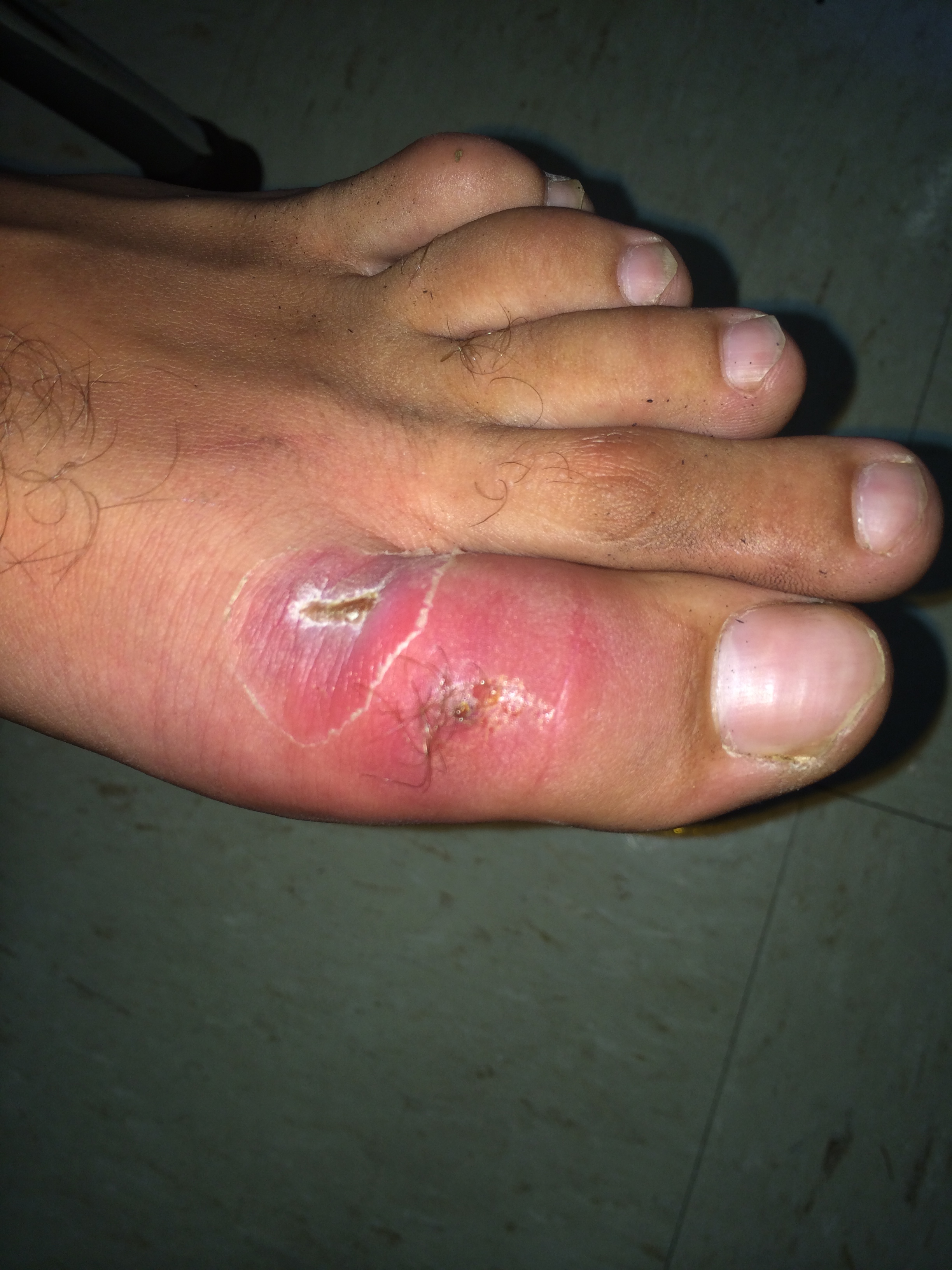
 Cellulitis is an infection of the skin and soft tissues. It is common and most often it’s caused by bacteria that normally live on the skin. These bacteria don’t normally cause any problems unless the skin is scratched, torn or punctured. The most common bacteria that cause cellulitis are streptococci “Strep” or staphylococci “Staph.”
Most of the time cellulitis is mild and heals with the use of antibiotics, however it can become severe and cause an infection that spreads throughout the body if left untreated. It can also lead to deep infections called abscesses.
Risk factors:
1) Chronic skin condition such as eczema or psoriasis
2) Accumulation of fluid (edema) due to poor circulation possibly from heart failure, liver disease, or removal of lymph nodes
3) Recent injury, wound, cut or laceration to the skin
4) Current skin infection such as athlete’s foot or impetigo
5) Being overweight
Symptoms: Pain, tenderness, increased warmth, redness and swelling in a distinct area of skin. The skin can be smooth and shiny in this area. Fever and chills are not usually present.
Other skin infections: different kinds of infections that can be confused with cellulitis include an abscess or boil. These are different because they are usually bumpy, raised and filled with pus. Abscesses are usually caused by a staph bacteria which may be MRSA. Cellulitis is more commonly caused by “strep” bacteria.
Treatment: We commonly use antibiotics and also treat the underlying problem that caused the skin infection (such as athlete’s food or increased edema, eczema or psoriasis) if present.
Keeping the area elevated to reduce inflammation is also helpful. It is important to keep the infected area clean and dry. Showering or bathing can be done normally, but pat the area dry with a clean towel afterwards to dry the area completely. You can also use a bandage or gauze to protect the skin if needed.
Antibiotics are often used and will be tailored to the individual patient. The patient’s specific area of infection, medical history, history of allergies and examination will be important in determining the proper antibiotics to use. Sometimes the antibiotics will need to be given by IV in more serious cases of cellulitis.
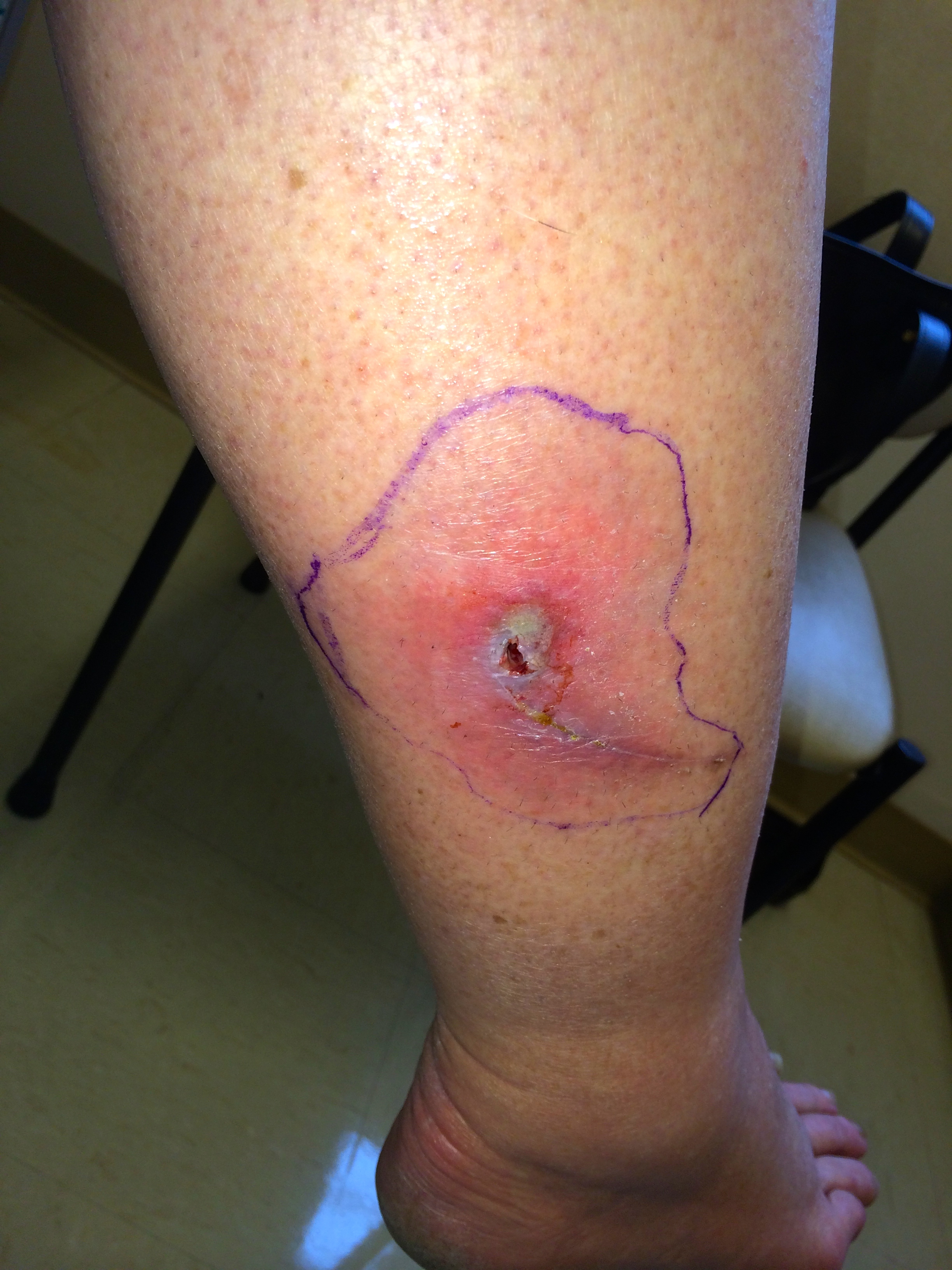
Treatment time: In most cases, the swelling, warmth and redness should improve within 1-3 days after starting the antibiotics. We often use a Sharpie marker and draw a circle around the area of redness so that we can examine the red area over a few days to see if it’s increasing, decreasing or staying the same. Symptoms of redness and swelling can persist for up to 2 weeks but it should be gradually decreasing. If it’s not improving, you should call or return to your health care provider for re-evaluation.
I hope that you have found this information useful. Wishing you the best of health,
Cellulitis is an infection of the skin and soft tissues. It is common and most often it’s caused by bacteria that normally live on the skin. These bacteria don’t normally cause any problems unless the skin is scratched, torn or punctured. The most common bacteria that cause cellulitis are streptococci “Strep” or staphylococci “Staph.”
Most of the time cellulitis is mild and heals with the use of antibiotics, however it can become severe and cause an infection that spreads throughout the body if left untreated. It can also lead to deep infections called abscesses.
Risk factors:
1) Chronic skin condition such as eczema or psoriasis
2) Accumulation of fluid (edema) due to poor circulation possibly from heart failure, liver disease, or removal of lymph nodes
3) Recent injury, wound, cut or laceration to the skin
4) Current skin infection such as athlete’s foot or impetigo
5) Being overweight
Symptoms: Pain, tenderness, increased warmth, redness and swelling in a distinct area of skin. The skin can be smooth and shiny in this area. Fever and chills are not usually present.
Other skin infections: different kinds of infections that can be confused with cellulitis include an abscess or boil. These are different because they are usually bumpy, raised and filled with pus. Abscesses are usually caused by a staph bacteria which may be MRSA. Cellulitis is more commonly caused by “strep” bacteria.
Treatment: We commonly use antibiotics and also treat the underlying problem that caused the skin infection (such as athlete’s food or increased edema, eczema or psoriasis) if present.
Keeping the area elevated to reduce inflammation is also helpful. It is important to keep the infected area clean and dry. Showering or bathing can be done normally, but pat the area dry with a clean towel afterwards to dry the area completely. You can also use a bandage or gauze to protect the skin if needed.
Antibiotics are often used and will be tailored to the individual patient. The patient’s specific area of infection, medical history, history of allergies and examination will be important in determining the proper antibiotics to use. Sometimes the antibiotics will need to be given by IV in more serious cases of cellulitis.
Treatment time: In most cases, the swelling, warmth and redness should improve within 1-3 days after starting the antibiotics. We often use a Sharpie marker and draw a circle around the area of redness so that we can examine the red area over a few days to see if it’s increasing, decreasing or staying the same. Symptoms of redness and swelling can persist for up to 2 weeks but it should be gradually decreasing. If it’s not improving, you should call or return to your health care provider for re-evaluation.
I hope that you have found this information useful. Wishing you the best of health,
Cellulitis of the lower leg often starts at a crack or a small cut on the foot, and with diabetic neuropathy that break can go unnoticed until the whole leg is red. It is the reason I keep after people about the diabetic foot check and what to look for.
Updated for 2026: Pus or No Pus Decides the Antibiotic
The most useful thing I can add to this post is a distinction that was fuzzy in 2012 and is now the thing the whole treatment decision turns on. Is there pus, or is there not. If there is an abscess, a pocket of pus you can feel giving under your finger, that is usually staph, MRSA is on the table, and it needs drainage plus an antibiotic that covers MRSA. I have written about that separately. If it is plain cellulitis, meaning spreading red, warm, tender skin with no drainable pocket, that is usually strep, and a cephalosporin like cephalexin is the right drug. Adding MRSA coverage on top does not help, and this has been tested directly. Moran and colleagues randomized patients with uncomplicated cellulitis to cephalexin plus trimethoprim-sulfamethoxazole or cephalexin alone. Cure was 83.5 percent against 85.5 percent (1). No benefit, two drugs, more side effects. So if you have been handed two antibiotics for a red leg with no abscess, that is worth a conversation. The 2014 infectious disease guidelines remain the operative document here and have not been superseded (2).Draw a Line Around It
This is the single most useful thing you can do, and it is more valuable to me on a video visit than almost anything else. Take a pen and trace the edge of the redness. Write the time next to it. Then photograph it. When we talk tomorrow, or if you end up in an urgent care instead, that line answers the only question that really matters, which is whether this is advancing, holding, or retreating. Redness that has crossed well past the line in a few hours is a different problem from redness that has not moved. Without the line, everyone is guessing from memory, and memory is bad at this.What I Can and Cannot Tell From a Screen
I can see color, extent, and whether there is an obvious pocket. I can ask about fever, chills, how fast it came on, whether there was a break in the skin, and how your blood sugars have been. What I cannot do is feel it. Warmth and firmness are things I am taking your word for, and the difference between cellulitis and something deeper and far more dangerous is partly a matter of how the tissue feels and how much pain there is relative to how it looks. That last one matters. Pain out of proportion to the appearance is a red flag I take seriously, and it is a reason for me to send you in rather than treat from here. Good photographs help more than people expect. Natural light, the same angle each time, and something for scale.When To Be Seen, Today
Fever or chills. Redness advancing visibly past your marked line. Pain that seems far worse than the skin looks, or skin that is dusky, blistering, or numb. Cellulitis on the face. Any of this in someone diabetic, immunosuppressed, or with poor circulation. And no improvement after forty eight hours on the right antibiotic. The rapidly advancing, severely painful ones are surgical emergencies, not prescriptions, and they are the reason I would rather over-refer than under-refer on this particular condition.The Bottom Line
No pus means a cephalosporin, and adding a second antibiotic for MRSA does not improve anything. Pus means drainage. Draw a line around the redness and note the time, because that line is the best data anyone will have.Sources
1. Moran GJ, et al. Effect of Cephalexin Plus Trimethoprim-Sulfamethoxazole vs Cephalexin Alone on Clinical Cure of Uncomplicated Cellulitis. JAMA. 2017;317(20):2088-2096. https://jamanetwork.com/journals/jama/fullarticle/2627970 2. Stevens DL, et al. Practice Guidelines for the Diagnosis and Management of Skin and Soft Tissue Infections: 2014 Update. Clin Infect Dis. 2014;59(2):e10-e52. https://www.idsociety.org/practice-guideline/skin-and-soft-tissue-infections/Related Reading
Abscesses and MRSA: What To Do About a Skin Infection Am I Truly Allergic to Penicillin? When to Use Telemedicine vs. Urgent Care: How I Spot the Sick One Scott Rennie, D.O.Board Certified in Obesity Medicine and Family Medicine
This blog is for educational purposes only and does not constitute individual medical advice. Always consult your own physician before making changes to your health, medications, or treatment plan.



 Doctor Rennie's Blog