Photo credit: http://www.pilonidalcystcure.com
A pilonidal cyst tends to announce itself in a particular way. They usually have complaints of difficulty sitting down or laying on their back because of pain.
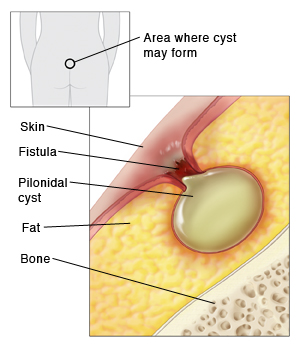
A pilonidal cyst is a fluid-filled sac that forms above the crease of the buttocks. The cysts are usually red, inflamed and most often infected when I see them. In many cases the cysts are hard, but sometimes they have a small hole in them where some fluid or blood has been draining. Pus (milky yellow/green fluid) is sometimes draining from them as well. The drainage often has a foul smell.
Cause: The cause of these cysts is not clear. They may form when a hair is forced under the skin or when a hair follicle ruptures. Or, a person may be born with the cyst. These cysts are often diagnosed in people between the ages of 16 and 26. But people of any age can have a pilonidal cyst. And they affect both men and women.
Treatment: We usually refer patients to a surgeon who can drain the cyst or remove it with surgery. They are often very painful, so performing an incision and drainage in the urgent care or clinic is often not possible because the patient requires a higher level of pain control and possibly conscious sedation to tolerate the procedure. To drain a cyst, the medical provider will first numb the area and then cut open the cyst with a scalpel and push the fluid out. They will then wash the area to clean it thoroughly and sometimes they might pack the empty cyst with gauze or leave a drain in place so that it doesn’t fill up with blood or pus again immediately. The drain or gauze can then be removed in a few days. We usually try to provide the patient with medication for pain, and often recommend sitting on a doughnut-like pillow with a hole in the center to help with pain.
Removing the cyst entirely often requires a more extensive surgical procedure because pilonidal cysts often have a sinus (small channel) that goes deep under the skin and can lead to another cyst or be deep enough to almost touch the sacrum or tailbone area. Patients with multiple cysts often need an even larger surgical procedure and consequently the recovery time can be much longer for multiple or larger cysts.
I hope that you have found this information useful. Wishing you the best of health,
Carrying extra weight is one of the recognized risk factors for pilonidal disease and for it coming back after surgery. Weight is the other half of my practice now, so if that is on your list, here is what Wegovy and Zepbound cost without insurance.
Related Reading
Abscesses and MRSA: What To Do About a Skin Infection
When to Use Telemedicine vs. Urgent Care: How I Spot the Sick One
Scott Rennie, D.O.
Board Certified in Obesity Medicine and Family Medicine
This blog is for educational purposes only and does not constitute individual medical advice. Always consult your own physician before making changes to your health, medications, or treatment plan.
 Doctor Rennie's Blog
Thank you!! You helped me to recognise my current condition and to know what to expect.
Wish you all the best!