
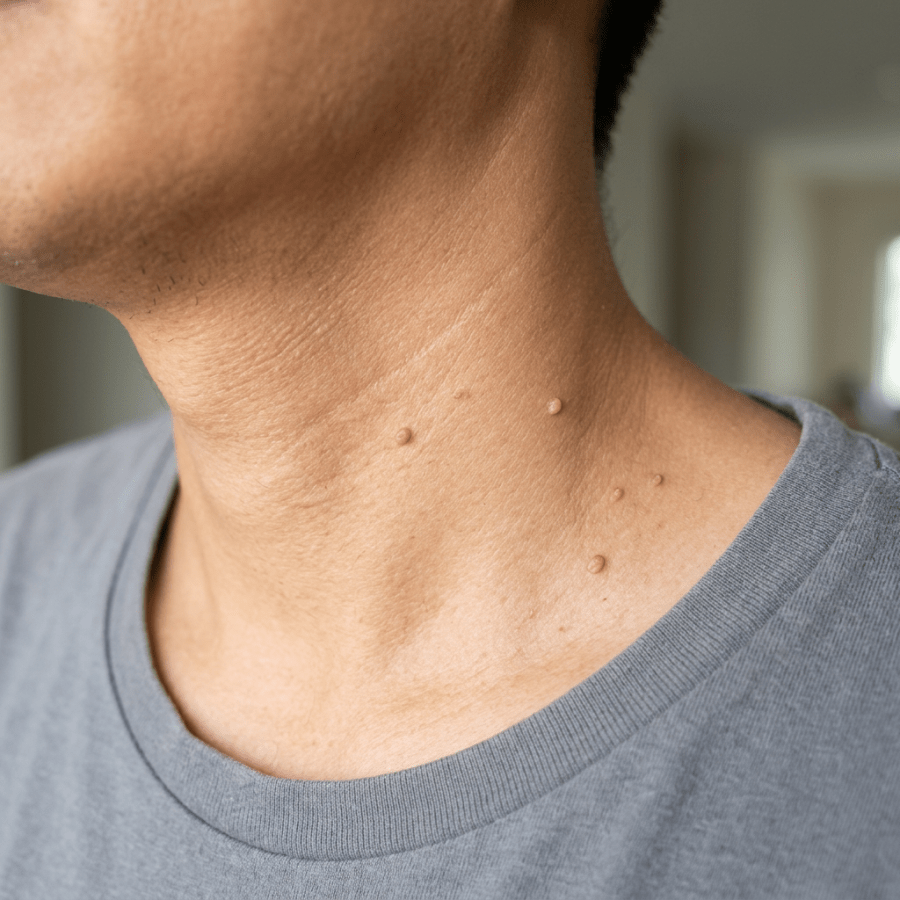
 Photo credit: http://www.your-doctor.net/dermatology_atlas/english/?id=38
Patients often come into the urgent care and ask about lesions on their skin. It’s a very good practice to have skin lesions examined by a medical provider because without actually seeing the lesion, it can be difficult to make the proper diagnosis. As you probably know, some skin lesions can be cancerous and so proper diagnosis is critical to ensure you get the right treatment and prevent complications.
Skin tags are non-cancerous lesions that are an outgrowth of normal skin. They occur in about 25% of adults and are more common as we age. They commonly occur at areas of skin friction such as in the armpit (axilla), on the neck, under the breast tissue, or in the groin. They can become painful when jewelry or clothing rub on them. If they get twisted, the blood supply to the skin tag can tear or become compromised and they sometimes change to a red or black color.
Diagnosis: I recommend that you have any skin lesion that you’re unsure about examined by a medical provider. If you have a history of skin cancer or family history of certain types of skin cancer, I recommend being examined by a dermatologist at least once a year and perhaps even more frequently. The diagnosis of skin tags is usually fairly easy based on the appearance, but they must be differentiated from other types of skin lesions that may look similar.
Treatment: If you have healthcare insurance, it may not provide coverage for removal of skin tags if they are being removed only for cosmetic reasons. Usually if they are painful or bleeding however, health insurance will cover the treatment for removal. Some possible treatment options for removal include:
1) Using forceps and fine grade scissors – these lesions often bleed vigorously so larger lesions may need suturing or cauterization
2) Cryosurgery or liquid nitrogen treatment. This freezing treatment is often done by super-cooling fine tipped forceps in liquid nitrogen and then gently squeezing the “stalk” of the skin tag to freeze it. The procedure of freezing and un-thawing is similar to treating warts.
3) Electrodessication
Recurrence: Unfortunately, skin tags can come back soon after they are treated.
To find a Dermatologist in your area, the American Academy of Dermatology’s Website has a very useful locator: http://www.aad.org/find-a-derm
I hope that you have found this information useful. Wishing you the best of health,
Photo credit: http://www.your-doctor.net/dermatology_atlas/english/?id=38
Patients often come into the urgent care and ask about lesions on their skin. It’s a very good practice to have skin lesions examined by a medical provider because without actually seeing the lesion, it can be difficult to make the proper diagnosis. As you probably know, some skin lesions can be cancerous and so proper diagnosis is critical to ensure you get the right treatment and prevent complications.
Skin tags are non-cancerous lesions that are an outgrowth of normal skin. They occur in about 25% of adults and are more common as we age. They commonly occur at areas of skin friction such as in the armpit (axilla), on the neck, under the breast tissue, or in the groin. They can become painful when jewelry or clothing rub on them. If they get twisted, the blood supply to the skin tag can tear or become compromised and they sometimes change to a red or black color.
Diagnosis: I recommend that you have any skin lesion that you’re unsure about examined by a medical provider. If you have a history of skin cancer or family history of certain types of skin cancer, I recommend being examined by a dermatologist at least once a year and perhaps even more frequently. The diagnosis of skin tags is usually fairly easy based on the appearance, but they must be differentiated from other types of skin lesions that may look similar.
Treatment: If you have healthcare insurance, it may not provide coverage for removal of skin tags if they are being removed only for cosmetic reasons. Usually if they are painful or bleeding however, health insurance will cover the treatment for removal. Some possible treatment options for removal include:
1) Using forceps and fine grade scissors – these lesions often bleed vigorously so larger lesions may need suturing or cauterization
2) Cryosurgery or liquid nitrogen treatment. This freezing treatment is often done by super-cooling fine tipped forceps in liquid nitrogen and then gently squeezing the “stalk” of the skin tag to freeze it. The procedure of freezing and un-thawing is similar to treating warts.
3) Electrodessication
Recurrence: Unfortunately, skin tags can come back soon after they are treated.
To find a Dermatologist in your area, the American Academy of Dermatology’s Website has a very useful locator: http://www.aad.org/find-a-derm
I hope that you have found this information useful. Wishing you the best of health,
Scott Rennie, D.O.
Board Certified in Obesity Medicine and Family Medicine
This blog is for educational purposes only and does not constitute individual medical advice. Always consult your own physician before making changes to your health, medications, or treatment plan.
 Doctor Rennie's Blog