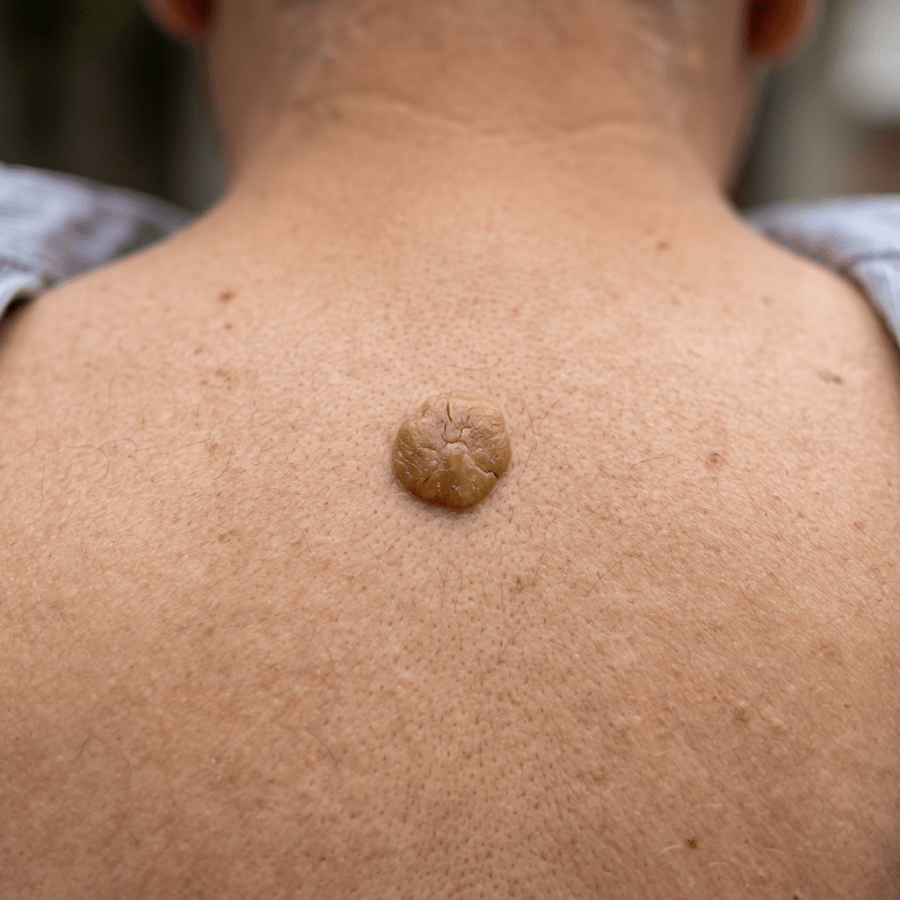
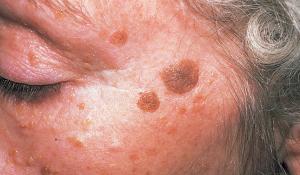
Photo credit: http://medicine.academic.ru/7367/Seborrheic_keratosis
Patients often come in to see their doctor because of skin lesions that they are unsure about. I encourage anyone with a skin lesion they are unsure about be evaluated by a medical provider because some lesions can be cancerous or pre-cancerous.
Seborrheic keratosis (SK’s) are very common, often developing after age 50 and occasionally as a young adult. They are non-cancerous lesions and are more common in some families (genetic). There is no way to prevent the development of new lesions.
They are non-cancerous but have been reported in association with a number of other skin malignancies, most commonly basal cell carcinomas and infrequently, melanoma. The sign of “Leser-Trelat,” is the sudden onset of multiple seborrheic keratoses in association with skin tags and acanthosis nigrans. This has been associated with a variety of cancers including gastrointestinal and lung cancers.
Diagnosis: The appearance of the lesions is usually characteristic “stuck-on” or “warty” looking and they may be tan, light brown or dark-brown to black. They are most commonly on the trunk of the body, face and arms/hands. They are often scaly. Microscopic examination is sometimes needed if they are small or atypical.
Treatment: These lesions do not need to be treated, but due to cosmetic reasons they can be removed. Insurance will usually not pay to have them removed unless they become painful, or bleed. They can be treated by:
1) Excisional biopsy – we send the specimen for examination under the microscope to rule out cancer if the lesion is suspicious
2) Shave excision
3) Cryotherapy with liquid nitrogen – sometimes a lighter skin pigment may occur after treatment and healing
Again, I encourage anyone with a skin lesion that they are unsure about be evaluated by a medical provider because some lesions can be cancerous or pre-cancerous.
To find a Dermatologist in your area, the American Academy of Dermatology’s Website has a very useful locator: http://www.aad.org/find-a-derm
I hope that you have found this information useful. Wishing you the best of health,
Scott Rennie, D.O.
Board Certified in Obesity Medicine and Family Medicine
This blog is for educational purposes only and does not constitute individual medical advice. Always consult your own physician before making changes to your health, medications, or treatment plan.
 Doctor Rennie's Blog