
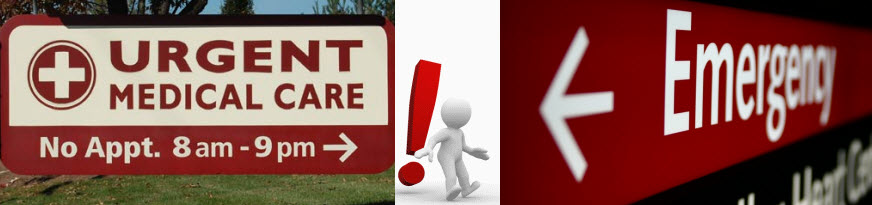
 Patients are often confused as to whether to go to a hospital emergency room or go to an urgent care clinic for various issues. Here is a list of some issues that may arise and where to go:
Emergency Room:
1) Allergy – if severe and having trouble breathing
2) Asthma – if severe and the patient might need to be admitted to the hospital
3) Chest Pain
4) Fractures with bone sticking out of the skin or visible deformity of the area
5) Confusion
6) Fainting
7) Head injury that is severe – severe with loss of consciousness
8) Headache that is the worst of your life
9) High fevers in babies younger than 1 year of age
10) Ingestion of obstructive objects – such as swallowing a coin
11) Ingestion of poisons
12) Major head injury
13) Heart palpitations
14) Pneumonia
15) Seizures
16) Severe abdominal pain
17) Severe burns
18) Severe headache
19) Shock
20) Significant trauma/injury
21) Snake bite
22) Unconscious or catatonic state
23) Uncontrollable bleeding
Urgent Care:
1) Allergies – if it’s a rash, hives or ear/nose/throat symptoms
2) Ankle sprain
3) Asthma attack (minor)
4) Back strain
5) Bronchitis
6) Colds, flu, fever
7) Cough
8) Dehydration
9) Dizziness
10) Ear infections
11) Head injury with no loss of consciousness and are acting normally after the accident without neurological/behavioral changes such as numbness, tingling, weakness, vomiting, trouble speaking or balance problems. In young children, they should be acting normal according to parents without increased sleepiness or irritability
12) Ingrown toenail
13) Insect bites
14) Migraines
15) Minor burns
16) Minor cuts – we can do stiches in the urgent care
17) Nausea
18) Pink eye
19) Rash
20) Simple fracture – without visible deformity to the involved area
21) Sinus infection
22) Sore throat
23) Sprains/strains
24) Stitches
25) Urinary tract infections
Remember, in an emergency, call 9-1-1
I hope that you have found this information useful. Wishing you the best of health,
Patients are often confused as to whether to go to a hospital emergency room or go to an urgent care clinic for various issues. Here is a list of some issues that may arise and where to go:
Emergency Room:
1) Allergy – if severe and having trouble breathing
2) Asthma – if severe and the patient might need to be admitted to the hospital
3) Chest Pain
4) Fractures with bone sticking out of the skin or visible deformity of the area
5) Confusion
6) Fainting
7) Head injury that is severe – severe with loss of consciousness
8) Headache that is the worst of your life
9) High fevers in babies younger than 1 year of age
10) Ingestion of obstructive objects – such as swallowing a coin
11) Ingestion of poisons
12) Major head injury
13) Heart palpitations
14) Pneumonia
15) Seizures
16) Severe abdominal pain
17) Severe burns
18) Severe headache
19) Shock
20) Significant trauma/injury
21) Snake bite
22) Unconscious or catatonic state
23) Uncontrollable bleeding
Urgent Care:
1) Allergies – if it’s a rash, hives or ear/nose/throat symptoms
2) Ankle sprain
3) Asthma attack (minor)
4) Back strain
5) Bronchitis
6) Colds, flu, fever
7) Cough
8) Dehydration
9) Dizziness
10) Ear infections
11) Head injury with no loss of consciousness and are acting normally after the accident without neurological/behavioral changes such as numbness, tingling, weakness, vomiting, trouble speaking or balance problems. In young children, they should be acting normal according to parents without increased sleepiness or irritability
12) Ingrown toenail
13) Insect bites
14) Migraines
15) Minor burns
16) Minor cuts – we can do stiches in the urgent care
17) Nausea
18) Pink eye
19) Rash
20) Simple fracture – without visible deformity to the involved area
21) Sinus infection
22) Sore throat
23) Sprains/strains
24) Stitches
25) Urinary tract infections
Remember, in an emergency, call 9-1-1
I hope that you have found this information useful. Wishing you the best of health,
Scott Rennie, D.O.
Board Certified in Obesity Medicine and Family Medicine
This blog is for educational purposes only and does not constitute individual medical advice. Always consult your own physician before making changes to your health, medications, or treatment plan.
 Doctor Rennie's Blog