
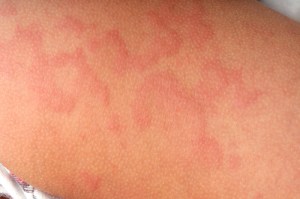
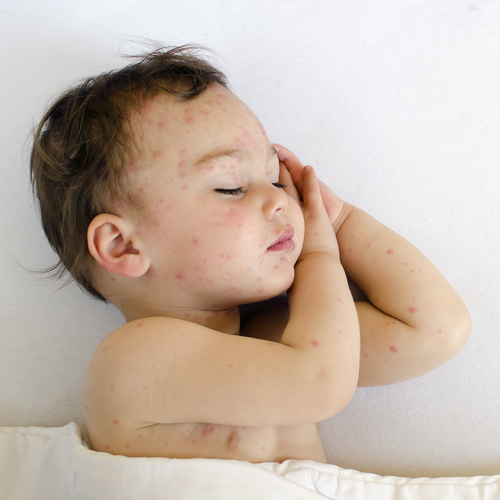
I had a patient who came in recently with his parents because he broke out in a rash all over his body after starting an antibiotic for an infection in his throat. The parents were obviously concerned that he was allergic to the antibiotic and wanted to know what to do to help him.
Allergies to medications, especially to antibiotics such as penicillin are common, but it’s sometimes confusing to know whether or not it’s a true drug allergy, a skin rash from the infection or perhaps not an allergy at all. Yesterday a patient told me that they are allergic to penicillin, and when I asked them what happens he takes it he said that he’s unsure – he just knows he allergic because his father was. I was alarmed that he thought he had an allergy to a potentially life saving medication only because a family member had long ago told him that they had an allergy to penicillin.
About 10% of patients report an allergy to penicillin when asked, however most people who believe they are allergic can take penicillin without a problem either because they were never truly allergic or because there allergy to penicillin has resolved over time. Only about 20% of people will be allergic to penicillin 10 years after the initial allergic reaction if they are not exposed to it again during this time period.
Definition: Penicillin is a common antibiotic that is prescribed for strep throat, ear infections as well as pneumonia and many other infections. It is part of a family of medications called beta lactams which include: Penicllin G, amoxicillin, ampicillin, oxacillin, cloxacillin, dicloxacillin, piperacillin, and nafcillin. A patient who is allergic to one of these penicillin medications is presumed to be allergic to any of them in this group.
The Reaction: It’s very important to tell your medical provider in as much detail as possible what the reaction is that happens if you take the medication rather than just listing it as an allergy. If your medical provider writes down that you are allergic to an antibiotic and it’s not a true allergy, this might mean that the next time they get an infection, you get a less effective or more toxic antibiotic.
It’s important to distinguish between a true allergy and “adverse reactions.” Adverse reactions are unexpected reactions that occur after taking a medication which are common but not true allergies. Some patients report an adverse reaction as an allergy because they don’t want to be given this medication in the future. For example, I had a patient tell me that they could not take prednisone because they are allergic. When I asked what happens if he takes it, he replied – “I don’t like the taste.” Unfortunately there are a limited number of medications, and they are most often grouped into families. If you are truly allergic to one medication in the family, this eliminates the possibility of taking any other medication in the same family. An entire group of potentially helpful medications might have been withheld from this patient only because he doesn’t like the taste of one of them in this group. Another example of a non-allergic adverse reaction is nausea and/or diarrhea. By listing penicillin as an allergy because the patient gets nausea or diarrhea after taking might lead to antibiotic failure or resistance which can be costly and prolong illness.
It’s important to keep in mind that the care that you receive by your medical providers when you are ill might be negatively impacted by an improperly labeled allergy in your medical records.
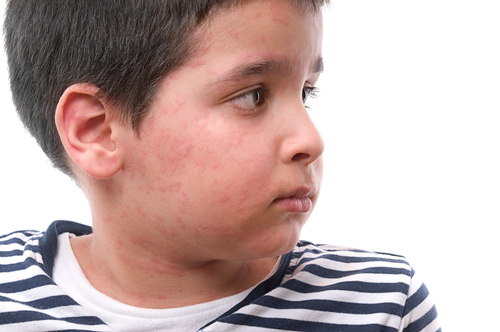
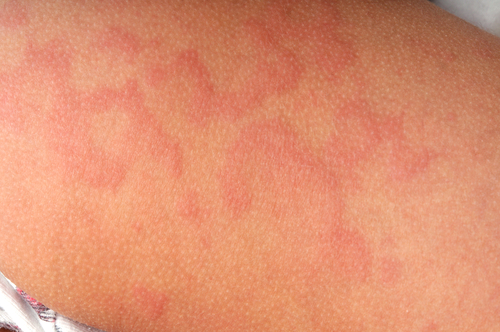
Rashes: There are different kinds of rashes that can occur after taking penicillin or other antibiotics. Some rashes such as hives are raised, intensely itchy and they come and go over hours. Another type of rash is flat, blotchy and spread over days but do not change by the hour and are less likely to represent a dangerous allergy. These rashes start after several days of treatment. We call these rashes a drug induced exanthem. Taking a photograph of your rash and bringing it to your doctor may be helpful if the rash changes.
True Allergic Reactions: hives, angioedema (swelling of the face/lips), throat tightness, wheezing, coughing, trouble breathing from asthma type reactions are all important to distinguish from “adverse reactions” as I mentioned above. When you list a medication allergy, make sure you describe which of these symptoms that the medication caused. These types of reactions only occur in 1-5% of people. It is important to tell your medical provider if you have had any of these symptoms because a past history indicates that the patient might develop a more severe infection such as anaphylaxis in the future if given the medication again.
Anaphylaxis: This is a true medical emergency caused by a potentially life-threatening allergic reaction. The symptoms involve the allergic reaction as well as low blood pressure, trouble breathing, abdominal pain, swelling of the throat or tongue and or diarrhea/vomiting.
Penicillin Allergy Testing: Testing for a penicillin allergy might be important ifin people who have a suspected penicillin allergy and require it to treat a life-threatening condition for which no alternative antibiotic is appropriate. It may also be appropriate for people who have frequent infections and have suspected allergies to many antibiotics, leaving few options for treatment. About 90% of patients tested will not have a penicillin allergy either because they lost the allergy over time or were never allergic in the first place. We do not routinely do allergy testing in the primary care or urgent care setting, it is done under the supervision of an allergist.
Cephalosporin Allergy: Allergic reactions are less common than reactions to penicillin. People with a penicillin allergy have a small risk of having an allergic reaction to cephalosporins. Cephalosporins are a class of antibiotics closely related to penicillin. Some of these medications include cephalexin, cefaclor, cefuroxime, cefadroxil, cepradine, cefprozil, loracarbef, ceftibuten, cefdinir, cefditoren, cefpodoxime, and cefixime.
Treatment: For true allergic reactions stopping the medications as soon as possible is obviously important. The following is an example of what I might do for a severe allergic reaction, but it may differ if you go a different facility or depending on the circumstances.
For mild urticaria: Observation and consider diphenhydramine 25-50 mg PO/IM or 25mg IV
For severe urticara: Diphenhydramine 25-50mg PO/IM or 25mg IV, Corticosteroids/Solumedrol 80-125mg IV, IV fluids and/or epinephrine at a dose of 0.3mg 1:1000 IM (Epi-Pen). If giving epinephrine, I usually have the patient transported to the hospital because they will need monitoring for rebound allergic reaction once the epinephrine wears off.
For Laryngeal Edema: Give O2 by mask 6-10L
For Anaphylaxis-like reactions: Suction as needed, elevate legs, O2 10L by mask, IV fluids (NS or LR), and Epinephrine 1:1000 0.3mg IM (Epi-Pen). For bronchospasm, add Albuterol MDI 2-3 puffs, Antihistamine: Diphenhydramine 25-50mg IM or IV and Corticosteroids/Solumedrol 80-125mg IV and await transport to the hospital
For Hypotension: Elevate legs, Oxygen by mask, use IV fluids, Epi-Pen and await transport to the hospital
Vagal Reaction: Elevate legs, 02 by mask at 10L, IV fluids (NS/LR wide open)
For Angina: 02 by mask at 10L, IV fluids: Administer slowly, Nitroglycerine 0.4mg sublingually; may repeat p5 min x 3 doses, Morphine 2mg IV and await transport to the hospital
For hypertension: 02 by mast at 10L, IV fluids: Administer slowly, Nitroglycerine 0.4mg sublingually, may repeat q5 minutes x 3 doses and await hospital transport
For seizures: Suction/Protect Airway and monitor for obstruction by tongue. O2 by mask if not vomiting. If caused by hypotension, treat accordingly and if uncontrolled consider anticonvulsant such as diazepam and await hospital transport
For hypoglycemia: O2 by mask at 10L, IV fluids D5W or glucose tablet
I recommend that patients who have known severe allergies to insect or bee stings carry an EpiPen with them.
If you’d like more information about allergic reactions to medications, check out the American Academy of Allergy Asthma & Immunology website:
http://www.aaaai.org/conditions-and-treatments/library/at-a-glance/medications-and-drug-allergic-reactions.aspx
I hope that you have found this information useful. Wishing you the best of health,
A penicillin allergy on the chart is one of the most common reasons a person ends up on azithromycin instead, which is a good part of why the Z-Pak became the default ask. I wrote about what I tell patients who ask for a Z-Pak.
Updated for 2026: This Is the Post That Aged the Worst
Of everything on this site, this is the topic where practice has moved furthest from what I wrote in 2012. Not refined. Moved.
In 2012, a penicillin allergy label meant skin testing, or more often it meant nobody tested anything and you spent your life on second choice antibiotics. That was the standard and I described it as such.
The current approach is different in a way that matters to you if you are carrying this label. For patients whose history is low risk, meaning a remote reaction, an isolated rash, a vague story nobody wrote down, or a reaction you only know about because a relative told you, the 2022 practice parameter from the allergy societies supports going straight to a supervised oral dose of amoxicillin. No skin testing first (1).
That sounds reckless if you learned it the old way. The trial says otherwise. PALACE randomized low risk adults to direct oral challenge or skin testing first, and the rate of positive reactions was identical, half a percent in each arm. Both reactions were mild and settled with an antihistamine (2).
Half a percent. That is the number to sit with. The label is wrong far more often than it is right.
The Ten Percent Cephalosporin Rule Was Wrong
Most of us were taught that if you are allergic to penicillin you have roughly a ten percent chance of reacting to cephalosporins, so avoid the whole class. That teaching is obsolete and it caused real harm, because it pushed patients onto broader and worse antibiotics for no reason.
What actually predicts cross reactivity is not the class. It is whether the two drugs share a similar side chain. A meta analysis of over twelve hundred penicillin allergic patients found cross reactivity of 16.45 percent when the side chain was identical, 5.60 percent when it was somewhat similar, and 2.11 percent when it was not (3). Carbapenems came in at 4.3 percent.
So the honest answer to whether you can take a cephalosporin is that it depends entirely on which cephalosporin, and most of them are fine.
Getting the Label Removed, and Making It Stay Off
This is something I can genuinely start in a video visit, and it is one of the more satisfying things I do.
The work is the history. What happened, how long after the dose, how old were you, did anyone see it, did you need treatment for it. Most of the time the answer is a childhood rash during a viral illness that got blamed on the amoxicillin, and that is not an allergy. From there I can tell you whether you look low risk and route you to a challenge, or whether your story needs an allergist first.
One caution from the follow up data. Six months after being formally delabeled, 6.6 percent of patients in PALACE were describing themselves as penicillin allergic again (4). The label creeps back. If you get delabeled, make sure it comes off your chart everywhere, tell your pharmacy, and do not reintroduce it at the next intake form out of habit.
Who Should Not Be Challenged
None of the above applies if your reaction was serious, and this is where I want to be unambiguous.
If you had hives, swelling of the lips or throat, wheezing, or a drop in blood pressure within minutes to hours of a dose, that is a different situation and you need an allergist, not a challenge. The same is true for the severe delayed reactions: blistering or peeling skin, sores in the mouth or eyes, a rash with fever and organ involvement, or a serum sickness type reaction. Those patients should never be given a test dose to see what happens (1).
And any active reaction with mouth or eye involvement, blistering, facial swelling, or trouble breathing is an emergency room problem, right now, not a video visit.
The Bottom Line
Around one in ten people carries this label and the overwhelming majority of them are not allergic. Getting it removed is not a formality. It gets you better antibiotics when you actually need them. If your story is a rash you had as a child, ask about a challenge.
Sources
1. Khan DA, et al. Drug allergy: A 2022 practice parameter update. J Allergy Clin Immunol. 2022;150(6):1333-1393. https://pubmed.ncbi.nlm.nih.gov/36122788/
2. Copaescu AM, et al. Efficacy of a Clinical Decision Rule to Enable Direct Oral Challenge in Patients With Low-Risk Penicillin Allergy: The PALACE Randomized Clinical Trial. JAMA Intern Med. 2023;183(9):944-952. https://pubmed.ncbi.nlm.nih.gov/37459086/
3. Picard M, Trubiano JA, Phillips EJ, Blumenthal KG, et al. Cross-Reactivity to Cephalosporins and Carbapenems in Penicillin-Allergic Patients: Two Systematic Reviews and Meta-Analyses. J Allergy Clin Immunol Pract. https://pubmed.ncbi.nlm.nih.gov/31170539/
4. Copaescu AM, et al. Risk of Self-Reported Penicillin Allergy Despite Removal of Penicillin Allergy Label: Secondary Analysis of the PALACE Randomized Clinical Trial. JAMA Netw Open. 2024;7(8):e2429621. https://jamanetwork.com/journals/jamanetworkopen/fullarticle/2822413
Related Reading
Abscesses and MRSA: What To Do About a Skin Infection
When to Use Telemedicine vs. Urgent Care: How I Spot the Sick One
Scott Rennie, D.O.
Board Certified in Obesity Medicine and Family Medicine
This blog is for educational purposes only and does not constitute individual medical advice. Always consult your own physician before making changes to your health, medications, or treatment plan.


 My dogs hate fireworks and I was just discussing what we are going to do with our dogs tomorrow night during all the fireworks. I will be working in the Urgent Care and my wife will be attending some 4th of July festivities with friends, so our dogs would be home alone. We will make accommodations so that they will not be alone. I came across an article that I thought was useful and timely regarding 4th of July safety tips for pet owners.
By:
My dogs hate fireworks and I was just discussing what we are going to do with our dogs tomorrow night during all the fireworks. I will be working in the Urgent Care and my wife will be attending some 4th of July festivities with friends, so our dogs would be home alone. We will make accommodations so that they will not be alone. I came across an article that I thought was useful and timely regarding 4th of July safety tips for pet owners.
By:












 Doctor Rennie's Blog