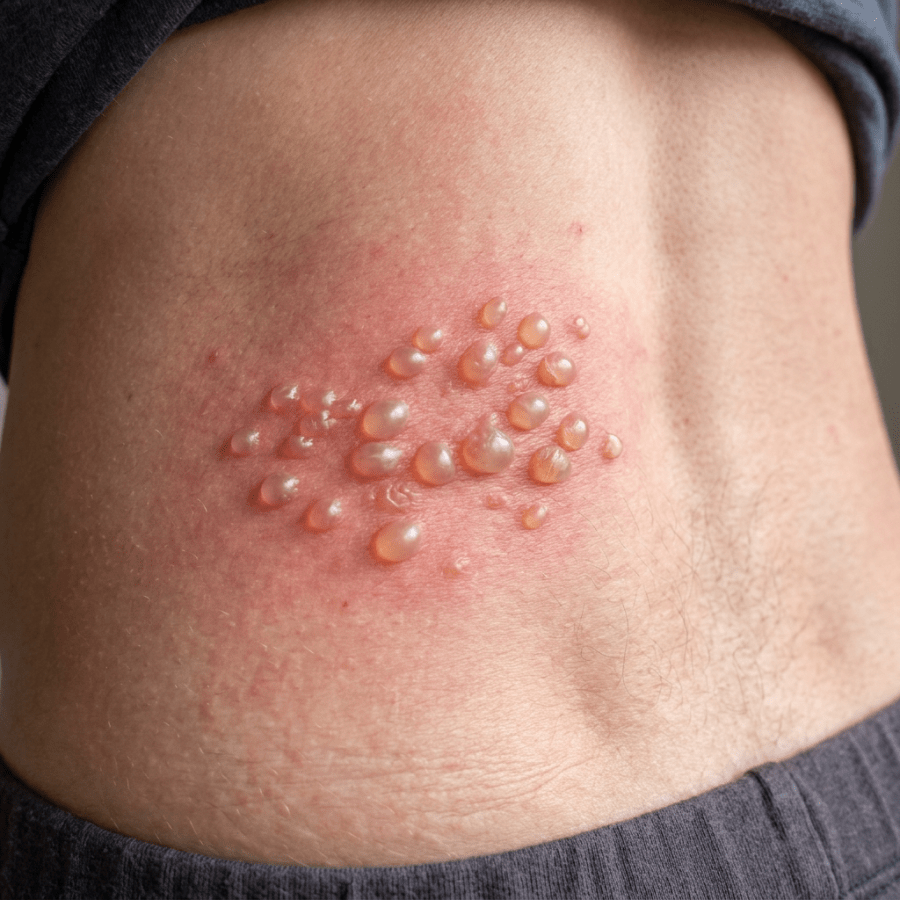
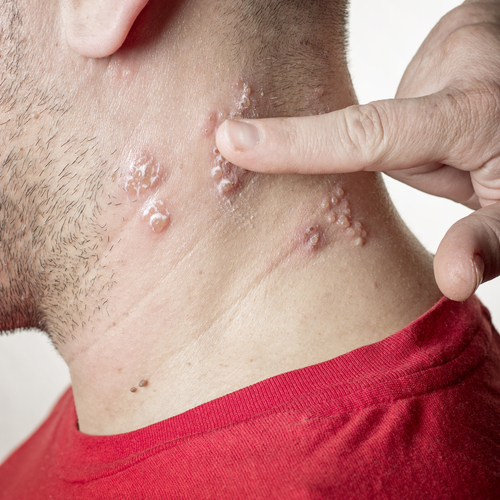
 Shingles, also called Herpes zoster is a painful rash caused by the same virus that causes chickenpox. The term “shingles” comes from the latin word “cingulum” which means belt or girdle; the rash usually appears in a band or belt-like pattern.
Singles can occur in people of all ages, but is more common in adults over age 50. It can also be more common in those people with a weakened immune system.
Cause: After chickenpox goes away, the virus retreats to cells in the nervous system and hides out there quietly for many years. Later in life, the varicella zoster virus can become active again and cause shingles. There are many different types of herpes virus and shingles/chickenpox are a different form of herpes than the type that cause cold sores or genital herpes. You are not at risk for getting cold sores or genital herpes by being around someone who has shingles or chickenpox.
Risk of getting shingles: About 20% of people will get shingles at some point in their life. Some people actually get the recurrence of shingles multiple times. Although it only occurs in people who have had chicken pox in the past, sometimes the chickenpox is mild enough that you might not even be aware that you have had it.
Weakened immune system: Certain people are more at risk for developing shingles if their immune system is compromised:
1) Chemotherapy treatment for cancer
2) Cancer itself can lower the immune system
3) HIV
4) Medications that suppress the immune system – such as after an organ transplantation or medications used to treat rheumatoid arthritis
Symptoms: Parasthesias are unusual sensations that may occur before any rash is noted. It’s described as a tingling, itching or burning in the area of skin on one side of the body. Some individuals develop a fever or headache, but many do not. Within a day or two a rash of blisters occur on one side of the body in a band-like pattern. The rash may occur on the chest, upper or lower back or even on the face. If it occurs on the face near the eye, it can permanently affect the vision, so we will often have those patients be seen by an eye doctor.
Shingles pain can be mild, moderate or severe and is usually described as a stabbing or burning pain. The pain usually stays in the area of the rash and can interfere with sleep and daily activities. Older adults typically have worse pain than younger patients.
After 3-4 days the blisters usually become open sores or ulcers. Rarely, the patient can develop a secondary bacterial infection in the area of the shingles rash. We treat any underlying bacterial infection with antibiotics. The sores then crust over and are not infectious after 7-10 days and the rash gradually resolves within 3-4 weeks. Scarring or skin changes can occur. Most of the time, no chronic problems occur after someone has a shingles outbreak.
Can I catch it from someone else? You can’t catch shingles from someone else but you can become infected with the varicella zoster virus. If you’ve never had chickenpox or the vaccine, you can develop it after being in contact with someone who has shingles. Even inhaling virus particles that are in the air can spread the infection. If you have had chickenpox or the vaccine, being near someone with shingles will not cause shingles or chickenpox.
Possible complications of shingles: Possible complications of a shingles infection can occur:
1) Pain called postherpetic neuralgia is the most common complication. Is is usually described as a burning pain that affects 10-15% of patients after the rash has resolved.
2) Skin infection from a bacteria can delay healing
3) Eye complications can occur if the virus is on the face near the eyes
Treatment: There are multiple medications that can be used to treat shingles. We try to keep the skin clean and dry to decrease the chance of developing a bacterial infection. Some options might include:
1) Antivirals such as acyclovir, famciclovir or valacyclovir are most effective when started within 3 days after the rash appears. They stop the virus from multiplying and speed the healing of skin lesions. This decreases the amount of pain the patient experiences
2) Pain medication such as Ibuprofen, Aleve or prescription pain medication may be prescribed
Return to work: If the blisters are on the face, it is best to remain off work until the area has crusted over which is usually 7-10 days. If the blisters can be covered, you can return to work after you are feeling well. If you work in a healthcare facility, please consult your healthcare provider.
Prevention: There is a vaccine to help reduce the risk of shingles. If a shingles infection occurs after the vaccine, it is usually less severe and there is less chances of developing post-herpetic neuralgia. We recommend the vaccine for adults over age 60. Even if you are unsure if you had chickenpox, we recommend the vaccine. We don’t give the vaccine to pregnant women, or those with a weakened immune system.
I hope that you have found this information useful. Wishing you the best of health,
Shingles, also called Herpes zoster is a painful rash caused by the same virus that causes chickenpox. The term “shingles” comes from the latin word “cingulum” which means belt or girdle; the rash usually appears in a band or belt-like pattern.
Singles can occur in people of all ages, but is more common in adults over age 50. It can also be more common in those people with a weakened immune system.
Cause: After chickenpox goes away, the virus retreats to cells in the nervous system and hides out there quietly for many years. Later in life, the varicella zoster virus can become active again and cause shingles. There are many different types of herpes virus and shingles/chickenpox are a different form of herpes than the type that cause cold sores or genital herpes. You are not at risk for getting cold sores or genital herpes by being around someone who has shingles or chickenpox.
Risk of getting shingles: About 20% of people will get shingles at some point in their life. Some people actually get the recurrence of shingles multiple times. Although it only occurs in people who have had chicken pox in the past, sometimes the chickenpox is mild enough that you might not even be aware that you have had it.
Weakened immune system: Certain people are more at risk for developing shingles if their immune system is compromised:
1) Chemotherapy treatment for cancer
2) Cancer itself can lower the immune system
3) HIV
4) Medications that suppress the immune system – such as after an organ transplantation or medications used to treat rheumatoid arthritis
Symptoms: Parasthesias are unusual sensations that may occur before any rash is noted. It’s described as a tingling, itching or burning in the area of skin on one side of the body. Some individuals develop a fever or headache, but many do not. Within a day or two a rash of blisters occur on one side of the body in a band-like pattern. The rash may occur on the chest, upper or lower back or even on the face. If it occurs on the face near the eye, it can permanently affect the vision, so we will often have those patients be seen by an eye doctor.
Shingles pain can be mild, moderate or severe and is usually described as a stabbing or burning pain. The pain usually stays in the area of the rash and can interfere with sleep and daily activities. Older adults typically have worse pain than younger patients.
After 3-4 days the blisters usually become open sores or ulcers. Rarely, the patient can develop a secondary bacterial infection in the area of the shingles rash. We treat any underlying bacterial infection with antibiotics. The sores then crust over and are not infectious after 7-10 days and the rash gradually resolves within 3-4 weeks. Scarring or skin changes can occur. Most of the time, no chronic problems occur after someone has a shingles outbreak.
Can I catch it from someone else? You can’t catch shingles from someone else but you can become infected with the varicella zoster virus. If you’ve never had chickenpox or the vaccine, you can develop it after being in contact with someone who has shingles. Even inhaling virus particles that are in the air can spread the infection. If you have had chickenpox or the vaccine, being near someone with shingles will not cause shingles or chickenpox.
Possible complications of shingles: Possible complications of a shingles infection can occur:
1) Pain called postherpetic neuralgia is the most common complication. Is is usually described as a burning pain that affects 10-15% of patients after the rash has resolved.
2) Skin infection from a bacteria can delay healing
3) Eye complications can occur if the virus is on the face near the eyes
Treatment: There are multiple medications that can be used to treat shingles. We try to keep the skin clean and dry to decrease the chance of developing a bacterial infection. Some options might include:
1) Antivirals such as acyclovir, famciclovir or valacyclovir are most effective when started within 3 days after the rash appears. They stop the virus from multiplying and speed the healing of skin lesions. This decreases the amount of pain the patient experiences
2) Pain medication such as Ibuprofen, Aleve or prescription pain medication may be prescribed
Return to work: If the blisters are on the face, it is best to remain off work until the area has crusted over which is usually 7-10 days. If the blisters can be covered, you can return to work after you are feeling well. If you work in a healthcare facility, please consult your healthcare provider.
Prevention: There is a vaccine to help reduce the risk of shingles. If a shingles infection occurs after the vaccine, it is usually less severe and there is less chances of developing post-herpetic neuralgia. We recommend the vaccine for adults over age 60. Even if you are unsure if you had chickenpox, we recommend the vaccine. We don’t give the vaccine to pregnant women, or those with a weakened immune system.
I hope that you have found this information useful. Wishing you the best of health,
When the pain outlasts the rash, gabapentin is one of the first drugs offered for postherpetic neuralgia, so it is worth reading where the gabapentin and dementia risk question stands before you start it.
Updated for 2026: The Vaccine in This Post No Longer Exists
That is not an exaggeration. When I wrote this in 2012, the shingles vaccine was Zostavax, a single live vaccine for adults sixty and over. Zostavax was discontinued in the United States on November 18, 2020 (1). You cannot get it. If this post sent you looking for it, that is on me, and here is what replaced it. Shingrix is now the only zoster vaccine available here. It is not live, it is given as two doses two to six months apart, and it is recommended for immunocompetent adults fifty and older (2). Two things people get wrong about it. You still need it if you have already had shingles. Having had it once does not protect you, and plenty of people get it twice. You also still need it if you had Zostavax years ago. Shingrix is recommended regardless (2).If Your Immune System Is Suppressed
This is the group that had nothing in 2012, and it is the change that matters most. Because Zostavax was a live vaccine, immunocompromised patients could not have it, and they are precisely the people at highest risk. Shingrix is not live. In October 2021 the recommendation was extended to immunocompromised adults nineteen and older (2). The protection is real, though lower than in healthy adults, and it varies by situation. In people who had received their own stem cell transplant it was 68.2 percent. In people with blood cancers, 87.2 percent. In people on immunosuppressants for immune mediated disease, 90.5 percent (2). If you are on a biologic, on chemotherapy, or post transplant and nobody has raised this with you, raise it yourself. The interval can be shortened to one to two months if you need protection sooner. One technical point worth knowing: if the second dose lands less than four weeks after the first it does not count and has to be repeated. If more than six months go by, you do not start over, you just get the second dose (2).Treatment, and the Seventy Two Hour Window
This part has not changed and it is still the thing that decides how your next few months go. Acyclovir 800 milligrams five times daily, valacyclovir 1,000 milligrams three times daily, or famciclovir 500 milligrams three times daily, all for seven days, and started within seventy two hours of the rash appearing (3). Seventy two hours. That is the whole game. Antivirals started inside that window shorten the illness and reduce the chance of the nerve pain that follows. Started late, they do much less. This is one of the better arguments for a same day video visit. You do not need anyone to touch you to start this, you need somebody to look at the rash quickly and act.The Pain That Comes After
Postherpetic neuralgia is the reason shingles has a reputation. For what actually helps, the numbers are worth seeing side by side, expressed as how many people need treating for one to benefit. Tricyclics like nortriptyline do best on paper, around three, though roughly a quarter of people stop them over side effects. Pregabalin up to 600 milligrams a day comes in around four. Gabapentin, at a genuinely therapeutic 1,800 to 3,600 milligrams a day, around eight. The clinician applied capsaicin 8 percent patch, around seven. The lidocaine 5 percent patch has a very good safety profile and thinner evidence behind it (3). The gabapentin number is the one I would flag. It works, but only if it is pushed to a real dose. A great deal of gabapentin gets prescribed at 300 milligrams at bedtime, never titrated, and then written off as ineffective. That is an under dosing problem, not a drug problem.When This Needs More Than a Video Visit
Shingles on the forehead, around the eye, or on the tip of the nose. That last one, the Hutchinson sign, predicts eye involvement, and this needs an ophthalmologist the same day, not tomorrow. A rash crossing more than about three dermatomes or scattered widely, especially if your immune system is suppressed, because that can mean the virus has spread internally. Facial droop, hearing change, or vertigo with a rash in or around the ear, which suggests Ramsay Hunt syndrome. Confusion, a stiff neck, or any neurologic change.The Bottom Line
If you are fifty or over, or nineteen and over with a suppressed immune system, get Shingrix, two doses, even if you have had shingles before and even if you had the old vaccine. If a rash starts, be seen within seventy two hours. And if you end up on gabapentin for the nerve pain afterward, make sure somebody actually titrates it.Sources
1. CDC. Zostavax discontinued in the United States as of November 18, 2020. https://archive.cdc.gov/www_cdc_gov/vaccines/vpd/shingles/public/zostavax/index.html 2. Anderson TC, et al. Use of Recombinant Zoster Vaccine in Immunocompromised Adults Aged 19 Years and Older: ACIP Recommendations, United States, 2022. MMWR. 2022;71(3):80-84. https://pmc.ncbi.nlm.nih.gov/articles/PMC8774159/ 3. Herpes Zoster and Postherpetic Neuralgia: Prevention and Management. American Family Physician. November 15, 2017. https://www.aafp.org/pubs/afp/issues/2017/1115/p656.htmlRelated Reading
When to Use Telemedicine vs. Urgent Care: How I Spot the Sick One Am I Truly Allergic to Penicillin? Scott Rennie, D.O.Board Certified in Obesity Medicine and Family Medicine
This blog is for educational purposes only and does not constitute individual medical advice. Always consult your own physician before making changes to your health, medications, or treatment plan.
 Doctor Rennie's Blog
You’re so awesome! I don’t suppose I have read through a single thing like
this before. So good to find another person with unique thoughts on this
topic. Really.. thank you for starting this up. This web site is one
thing that’s needed on the web, someone with some originality!