
 I credit much of this information to Dr. Howard Donner who has incredible knowledge of both medicine and the wilderness. He is also an excellent teacher.
Drinking water can be contaminated with bacteria, viruses, protozoa and other parasites. The risks of getting ill depends on the number of organisms that are consumed which is determined by the volume of water, concentration of organisms and how well the water treatment system is working.
Disinfection: Removal or destruction of harmful microorganisms
Pasteurization: Similar to disinfection but uses heat at temperatures below 100 degree C to kill most pathogenic organisms
Sterilization: Destruction or removal of all life forms – not to be confused with disinfection or pasteurization
Purification: Removal of organic and inorganic chemicals and particulate matter to remove offensive color, taste and odor. It may not remove or kill enough microorganisms to ensure microbiologic safety.
The goal of disinfecting water is to achieve minimal microbial hazard so that the likelihood of illness is acceptable. Sterilization is not necessary because all life forms are not human pathogens.
Water treatment methods: Heat, Filtration and Clarification, Ultraviolet light
Disinfection by Heat:
1) The boiling time required is important when fuel is limited
2) Most pathogens including cysts, bacteria, viruses and parasites can be killed at a temperature well below boiling
3) Thermal death is a function of both time and temperature; therefore, lower temperatures are effective with longer contact times
4) Microorganisms have varying sensitivity to heat; however all common bacteria that cause diarrhea are readily inactivated by heat
5) Hepatitis A is a special concern because it seems to have greater thermal resistance
6) Elevation should not make a large difference unless hepatitis A is a concern because heat inactivation occurs below typical boiling temperatures
7) The 10 minute boiling rule is for sterilization of water. Enteric pathogens are killed within seconds by boiling water and rapidly above 140 degrees. The majority of the time required raiding the temperature of the water to boiling point works toward disinfection so water is safe to drink by the time it has reached a full boil. For extra safety against hepatitis A, keep the water covered and hot for several minutes after boiling
8) A pressure cooker saves times and fuel at all elevations
9) Pasteurization has been achieved using solar heating using a foil-lined cardboard box with a glass window in the lid.
Disinfection by Filtration:
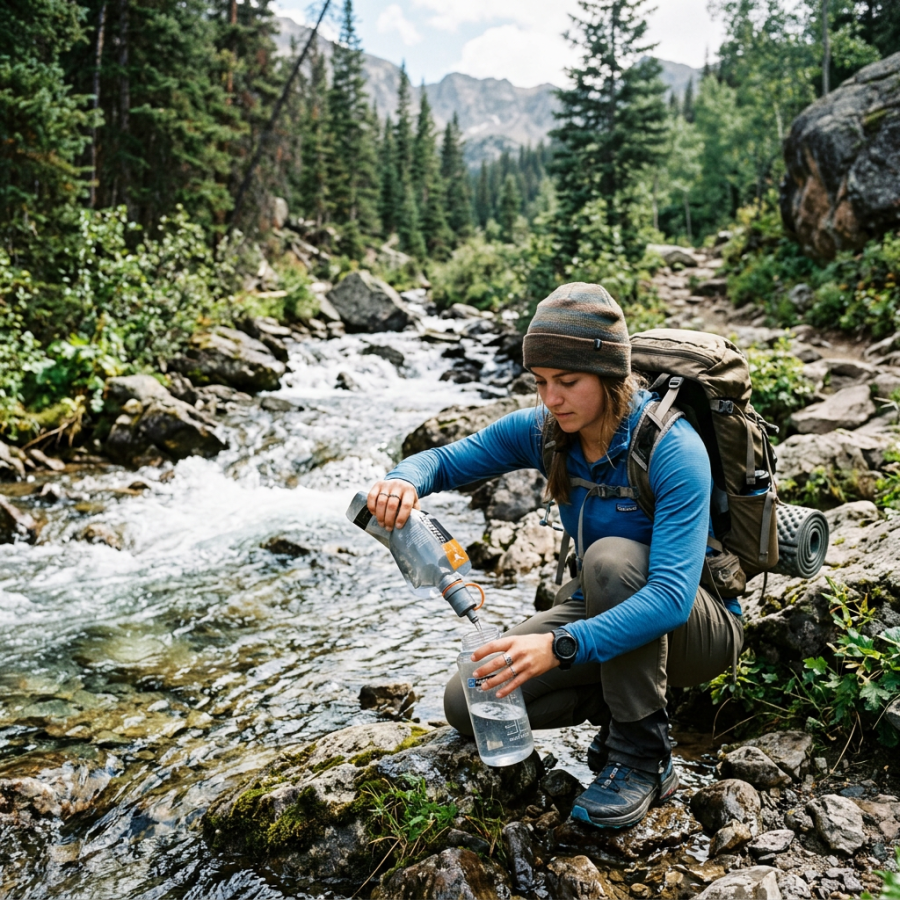
1) Field filters rely on mechanical removal of microorganisms and are adequate for cysts, and bacteria but do not reliably remove viruses which are a major concern in water where high levels of fecal contamination are present (e.g., in developing countries)
2) The advantage is they are simple and require no holding time
3) They do not add any unpleasant taste and may improve taste and appearance of the water
4) Most viruses adhere to larger particles or clump together into larger aggregates that me be removed by a filter, but filtration alone is not adequate because the infectious dose of the virus may be quite small.
5) Filters are often expensive and can add considerable weight and bulk to the backpack
6) The filter pore size that is required to remove microorganisms is difficult to determine because the organisms possess elasticity and deform under pressure and that makes it possible for them to squeeze through filter pores.
7) Filters are rated by their ability to retain particles of a certain size which is described by two terms. Absolute rating means that 100% of a certain size of particle is retained in the filter. Nominal rating indicates that more than 90% of a given particle size will be retained.
8) All filters eventually clog from suspended particulate matter even in clear streams. This means that they require cleaning or filter replacement. The ability to field service the unit easily is an advantage.
9) As the filter clogs, it requires increasing pressure to drive the water through which can force microorganisms through the filter.
Reverse Osmosis Disinfection:
1) Reverse osmosis filters use high pressure (100 to 800 psi) to force water through semipermeable membranes that filter out dissolved ions, molecules and solids
2) Generally used for desalinating water, but may also be used to remove biological contaminants
3) Small hand-pumped reverse osmosis units have been developed but their high price and slow output currently limit their use by land based wilderness travelers. They are an essential survival item for ocean travelers
Clarification of cloudy water can be achieved by sedimentation, coagulation-flocculation(CF), or adsorption.
1) Large particles settle by gravity over 1-2 hours in sedimentation. Which can help if you are using a filter. Although filters remove particulate debris, thus improving the appearance and taste of “dirty” water, they clog quickly if the water contains large particles. Using sedimentation allows the larger particles to settle out to the bottom of the container helps prevent the filters from clogging so quickly.
2) Smaller suspended particles can be removed by coagulation-flocculation(C-F). This is accomplished in the field by adding alum (aluminum potassium sulfate). Alum is used in the food industry as a pickling powder and is nontoxic. C-F will remove contaminants that cause unpleasant color and taste as well as some dissolved metals and some microorganisms.
Water Clarification using Alum:
1) Add a pinch of alum to each gallon of water
2) Mix well, and stir occasionally for 30 minutes then allow 30-60 minutes for settling
3) The water should be clear, if it is not then add another pinch of alum and repeat
4) Decant or pour the water through a paper filter to remove clumps of flocculate.
Charcoal filters/Granular Activated Charcoal (GAC): Removes organic pollutants, chemicals, and radioactive particles by adsorption. This improves the color, taste and smell of the water. Although some microorganisms adhere to the GAC or become trapped in the charcoal filters, GAC does not remove all microorganisms, so it does not disinfect.
1) Useful for removing halogens such as iodine or chlorine after disinfection
2) Wait until after the contact time for disinfection before running water through charcoal if you use it to remove the iodine or chlorine from your water
3) Some filters use iodine resins followed by GAC and rely on a different dynamic
Halogens: Chlorine and Iodine are effective disinfectants against bacteria, viruses, Giardia and cysts of amebae but not Cryptosporidium. They are not expensive.
1) Disinfection with halogens depends on both the concentration of the halogen and the amount of time the halogen is in contact with the water (contact time). Increase in one allows a decrease in the other (inverse relationship).
2) Water temperature and the presence of organic contaminants in the water affect this method (colder temperatures slow and organic contaminants decrease its disinfection action). Thus, in cold water, the contact time or dose should be increased and in polluted water the dose must be increased
3) Use 4 parts per million (ppm) as a target concentration for surface water and allow extra contact time if the water is cold.
4) In cloudy water that will not settle out by sedimentation, the halogen dose should be at least 8ppm. Ideally, use C-F to clarify the water before halogenation, then a smaller amount of halogen may be used.
Organism sensitivity to halogens:
1) Bacteria are very sensitive to halogens
2) Viruses and Giardia require higher concentrations or longer contact times
3) Certain parasite eggs such as round worms are resistant but they are usually not spread in the water. These eggs or cysts are susceptible to heat or filtration
4) Cryptosporidium cysts are extremely resistant to halogens
Chlorine vs. Iodine:
1) Iodine is less affected by pH and tastes better than Chlorine
2) Chlorine and Iodine are available in liquid or tablet forms
3) Some people have allergic reactions to iodine
4) Iodine use is not recommended for people with unstable thyroid disease or unknown iodine allergy
5) Iodine should not be used during pregnancy for longer than several weeks because of risk of neonatal goiter
6) Limit exposure to drinking iodinated water to 1 month or less if all water being consumed is treated with iodine
7) Iodine resins with GAC filters may reduce iodine exposure because they have lower concentration of iodine and remove it with the filter
Problems with halogens:
1) The taste of water can be unpleasant
2) The potency of some products (both tablets and solution) decrease with time an are affected by heat or moisture
3) Liquids are corrosive and can stain clothes or equipment
4) Cryptosporidium are resistant
5) The actual concentration (after halogen demand – ie amount of organic material in water) is unknown
Improving the Taste of Water that has been disinfected with halogens: Add flavoring to the water only after adequate contact time because the sugar and additives can reduce the amount of free iodine available. Also using charcoal (GAC) to remove the halogen after contact time. You may also reduce the concentration and increase the contact time for clean water. You can use a collapsible plastic container to disinfect water with low doses of iodine during the day or overnight. You can also add a few granules per liter of ascorbic acid (vitamin C) in powder or crystal form after the contact time and this will take out the color and taste of the chlorine or iodine.
Superchlorination-Dechlorination: High doses of chlorine are added to the water in the form of calcium hypochlorite crystals to achieve concentrations of 30-200 ppm of free chlorine that are above the margin of safety for field conditions and rapidly kill all bacteria, viruses and protozoa. After 10-15 minutes, several drops of 30% hydrogen peroxide solution are added. The minor disadvantage of the two-step process is excellent taste. This is a good technique for highly polluted or cloudy water and for disinfecting large quantities of water.
Mixed Species Disinfection (Miox Purifier): Passing a current through a simple brine sale solution generates free available chlorine, as well as other “mixed species” disinfectants that have been demonstrated effective against bacteria, viruses and bacterial spores. There is potential for malfunction and battery depletion. A new point-of-use commercial product is available – Miox marketed by MSR.
Chlorine Dioxide: This is capable of inactivating most waterborne pathogens including Cryptosporidium parvum oocysts at practical doses and contact times. It is at least as effective a bactericide as chlorine and in many cases it’s superior. It’s far better against viruses.
Ultraviolet Light: In sufficient doses, all waterborne enteric pathogens are inactivated by UV radiation. UV treatment does not require chemicals and does not affect the taste of the water. UV works rapidly and overdose to the water does not cause any problems. It has no residual disinfection power and water may become re-contaminated or regrowth of bacteria can occur. Particulates in the water however can shield microorganisms from UV rays. Where strong sunshine is available, solar disinfection of drinking water is an effective, low-cost method for improving water quality and may be very useful in refugee camps and disaster areas.
If you are interested in learning more about wilderness medicine, a great resource for information is the wilderness medicine society: http://www.wms.org/
I hope that you have found this information useful. Wishing you the best of health,
I credit much of this information to Dr. Howard Donner who has incredible knowledge of both medicine and the wilderness. He is also an excellent teacher.
Drinking water can be contaminated with bacteria, viruses, protozoa and other parasites. The risks of getting ill depends on the number of organisms that are consumed which is determined by the volume of water, concentration of organisms and how well the water treatment system is working.
Disinfection: Removal or destruction of harmful microorganisms
Pasteurization: Similar to disinfection but uses heat at temperatures below 100 degree C to kill most pathogenic organisms
Sterilization: Destruction or removal of all life forms – not to be confused with disinfection or pasteurization
Purification: Removal of organic and inorganic chemicals and particulate matter to remove offensive color, taste and odor. It may not remove or kill enough microorganisms to ensure microbiologic safety.
The goal of disinfecting water is to achieve minimal microbial hazard so that the likelihood of illness is acceptable. Sterilization is not necessary because all life forms are not human pathogens.
Water treatment methods: Heat, Filtration and Clarification, Ultraviolet light
Disinfection by Heat:
1) The boiling time required is important when fuel is limited
2) Most pathogens including cysts, bacteria, viruses and parasites can be killed at a temperature well below boiling
3) Thermal death is a function of both time and temperature; therefore, lower temperatures are effective with longer contact times
4) Microorganisms have varying sensitivity to heat; however all common bacteria that cause diarrhea are readily inactivated by heat
5) Hepatitis A is a special concern because it seems to have greater thermal resistance
6) Elevation should not make a large difference unless hepatitis A is a concern because heat inactivation occurs below typical boiling temperatures
7) The 10 minute boiling rule is for sterilization of water. Enteric pathogens are killed within seconds by boiling water and rapidly above 140 degrees. The majority of the time required raiding the temperature of the water to boiling point works toward disinfection so water is safe to drink by the time it has reached a full boil. For extra safety against hepatitis A, keep the water covered and hot for several minutes after boiling
8) A pressure cooker saves times and fuel at all elevations
9) Pasteurization has been achieved using solar heating using a foil-lined cardboard box with a glass window in the lid.
Disinfection by Filtration:
1) Field filters rely on mechanical removal of microorganisms and are adequate for cysts, and bacteria but do not reliably remove viruses which are a major concern in water where high levels of fecal contamination are present (e.g., in developing countries)
2) The advantage is they are simple and require no holding time
3) They do not add any unpleasant taste and may improve taste and appearance of the water
4) Most viruses adhere to larger particles or clump together into larger aggregates that me be removed by a filter, but filtration alone is not adequate because the infectious dose of the virus may be quite small.
5) Filters are often expensive and can add considerable weight and bulk to the backpack
6) The filter pore size that is required to remove microorganisms is difficult to determine because the organisms possess elasticity and deform under pressure and that makes it possible for them to squeeze through filter pores.
7) Filters are rated by their ability to retain particles of a certain size which is described by two terms. Absolute rating means that 100% of a certain size of particle is retained in the filter. Nominal rating indicates that more than 90% of a given particle size will be retained.
8) All filters eventually clog from suspended particulate matter even in clear streams. This means that they require cleaning or filter replacement. The ability to field service the unit easily is an advantage.
9) As the filter clogs, it requires increasing pressure to drive the water through which can force microorganisms through the filter.
Reverse Osmosis Disinfection:
1) Reverse osmosis filters use high pressure (100 to 800 psi) to force water through semipermeable membranes that filter out dissolved ions, molecules and solids
2) Generally used for desalinating water, but may also be used to remove biological contaminants
3) Small hand-pumped reverse osmosis units have been developed but their high price and slow output currently limit their use by land based wilderness travelers. They are an essential survival item for ocean travelers
Clarification of cloudy water can be achieved by sedimentation, coagulation-flocculation(CF), or adsorption.
1) Large particles settle by gravity over 1-2 hours in sedimentation. Which can help if you are using a filter. Although filters remove particulate debris, thus improving the appearance and taste of “dirty” water, they clog quickly if the water contains large particles. Using sedimentation allows the larger particles to settle out to the bottom of the container helps prevent the filters from clogging so quickly.
2) Smaller suspended particles can be removed by coagulation-flocculation(C-F). This is accomplished in the field by adding alum (aluminum potassium sulfate). Alum is used in the food industry as a pickling powder and is nontoxic. C-F will remove contaminants that cause unpleasant color and taste as well as some dissolved metals and some microorganisms.
Water Clarification using Alum:
1) Add a pinch of alum to each gallon of water
2) Mix well, and stir occasionally for 30 minutes then allow 30-60 minutes for settling
3) The water should be clear, if it is not then add another pinch of alum and repeat
4) Decant or pour the water through a paper filter to remove clumps of flocculate.
Charcoal filters/Granular Activated Charcoal (GAC): Removes organic pollutants, chemicals, and radioactive particles by adsorption. This improves the color, taste and smell of the water. Although some microorganisms adhere to the GAC or become trapped in the charcoal filters, GAC does not remove all microorganisms, so it does not disinfect.
1) Useful for removing halogens such as iodine or chlorine after disinfection
2) Wait until after the contact time for disinfection before running water through charcoal if you use it to remove the iodine or chlorine from your water
3) Some filters use iodine resins followed by GAC and rely on a different dynamic
Halogens: Chlorine and Iodine are effective disinfectants against bacteria, viruses, Giardia and cysts of amebae but not Cryptosporidium. They are not expensive.
1) Disinfection with halogens depends on both the concentration of the halogen and the amount of time the halogen is in contact with the water (contact time). Increase in one allows a decrease in the other (inverse relationship).
2) Water temperature and the presence of organic contaminants in the water affect this method (colder temperatures slow and organic contaminants decrease its disinfection action). Thus, in cold water, the contact time or dose should be increased and in polluted water the dose must be increased
3) Use 4 parts per million (ppm) as a target concentration for surface water and allow extra contact time if the water is cold.
4) In cloudy water that will not settle out by sedimentation, the halogen dose should be at least 8ppm. Ideally, use C-F to clarify the water before halogenation, then a smaller amount of halogen may be used.
Organism sensitivity to halogens:
1) Bacteria are very sensitive to halogens
2) Viruses and Giardia require higher concentrations or longer contact times
3) Certain parasite eggs such as round worms are resistant but they are usually not spread in the water. These eggs or cysts are susceptible to heat or filtration
4) Cryptosporidium cysts are extremely resistant to halogens
Chlorine vs. Iodine:
1) Iodine is less affected by pH and tastes better than Chlorine
2) Chlorine and Iodine are available in liquid or tablet forms
3) Some people have allergic reactions to iodine
4) Iodine use is not recommended for people with unstable thyroid disease or unknown iodine allergy
5) Iodine should not be used during pregnancy for longer than several weeks because of risk of neonatal goiter
6) Limit exposure to drinking iodinated water to 1 month or less if all water being consumed is treated with iodine
7) Iodine resins with GAC filters may reduce iodine exposure because they have lower concentration of iodine and remove it with the filter
Problems with halogens:
1) The taste of water can be unpleasant
2) The potency of some products (both tablets and solution) decrease with time an are affected by heat or moisture
3) Liquids are corrosive and can stain clothes or equipment
4) Cryptosporidium are resistant
5) The actual concentration (after halogen demand – ie amount of organic material in water) is unknown
Improving the Taste of Water that has been disinfected with halogens: Add flavoring to the water only after adequate contact time because the sugar and additives can reduce the amount of free iodine available. Also using charcoal (GAC) to remove the halogen after contact time. You may also reduce the concentration and increase the contact time for clean water. You can use a collapsible plastic container to disinfect water with low doses of iodine during the day or overnight. You can also add a few granules per liter of ascorbic acid (vitamin C) in powder or crystal form after the contact time and this will take out the color and taste of the chlorine or iodine.
Superchlorination-Dechlorination: High doses of chlorine are added to the water in the form of calcium hypochlorite crystals to achieve concentrations of 30-200 ppm of free chlorine that are above the margin of safety for field conditions and rapidly kill all bacteria, viruses and protozoa. After 10-15 minutes, several drops of 30% hydrogen peroxide solution are added. The minor disadvantage of the two-step process is excellent taste. This is a good technique for highly polluted or cloudy water and for disinfecting large quantities of water.
Mixed Species Disinfection (Miox Purifier): Passing a current through a simple brine sale solution generates free available chlorine, as well as other “mixed species” disinfectants that have been demonstrated effective against bacteria, viruses and bacterial spores. There is potential for malfunction and battery depletion. A new point-of-use commercial product is available – Miox marketed by MSR.
Chlorine Dioxide: This is capable of inactivating most waterborne pathogens including Cryptosporidium parvum oocysts at practical doses and contact times. It is at least as effective a bactericide as chlorine and in many cases it’s superior. It’s far better against viruses.
Ultraviolet Light: In sufficient doses, all waterborne enteric pathogens are inactivated by UV radiation. UV treatment does not require chemicals and does not affect the taste of the water. UV works rapidly and overdose to the water does not cause any problems. It has no residual disinfection power and water may become re-contaminated or regrowth of bacteria can occur. Particulates in the water however can shield microorganisms from UV rays. Where strong sunshine is available, solar disinfection of drinking water is an effective, low-cost method for improving water quality and may be very useful in refugee camps and disaster areas.
If you are interested in learning more about wilderness medicine, a great resource for information is the wilderness medicine society: http://www.wms.org/
I hope that you have found this information useful. Wishing you the best of health,
Scott Rennie, D.O.
Board Certified in Obesity Medicine and Family Medicine
This blog is for educational purposes only and does not constitute individual medical advice. Always consult your own physician before making changes to your health, medications, or treatment plan.
 Doctor Rennie's Blog