 Photo credit: http://fluconazole.biz/fluconazole-resistant-tinea/
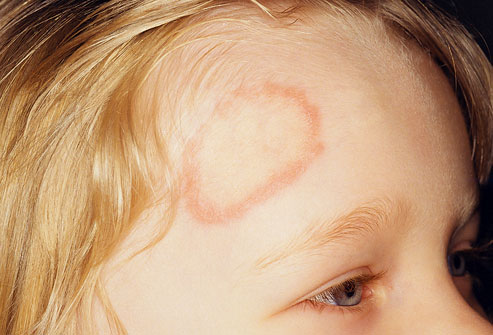
People come to their doctor quite frequently due to fungal infections of the skin or nails. One might think that because of the name, “Ringworm,” it would be caused by a worm, but it is actually caused by a fungus. The shape of the rash looks like a ring and thus it got its name. It’s a red, itchy rash on the skin and is also caused tinea.
Four different type of ringworm infections are named for the body-part that is affected:
1) Tinea capitis affects the head or scalp and is mostly seen in children
2) Tinea pedis affects the feet and is called athlete’s food because athlete’s common acquire it in the locker room
3) Tinea cruris affects the groin and is also called jock itch because it also commonly affects athletes or “jocks” presumably because of the moisture on the skin that the fungus prefers
4) Tinea corporis is a term for fungal infections that affect other body surfaces
Ringworm is a contagious infection and can be spread by someone else who is infected or even by an infected dog or cat. It may be spread in a shower stall, locker room floor or pool area. Often small skin shavings from the infected person are left behind in these areas and an unknowing person touches the infected area with their feet or other body part.
Tinea capitis: a fungal infection of the scalp may be related to cradle cap in children. It causes a red scaly rash and can lead to bald patches. It rarely affects adults. We treat scalp infections with either oral or topical medications or a combination of both. Children often improve with the use of gentle massage of the scalp during a bath to remove the scaly areas and then use of an antifungal medical on the scalp to kill the bacteria. Adults and children are usually treated with oral medications and treatment can take 2-12 weeks depending on the severity of the infection.
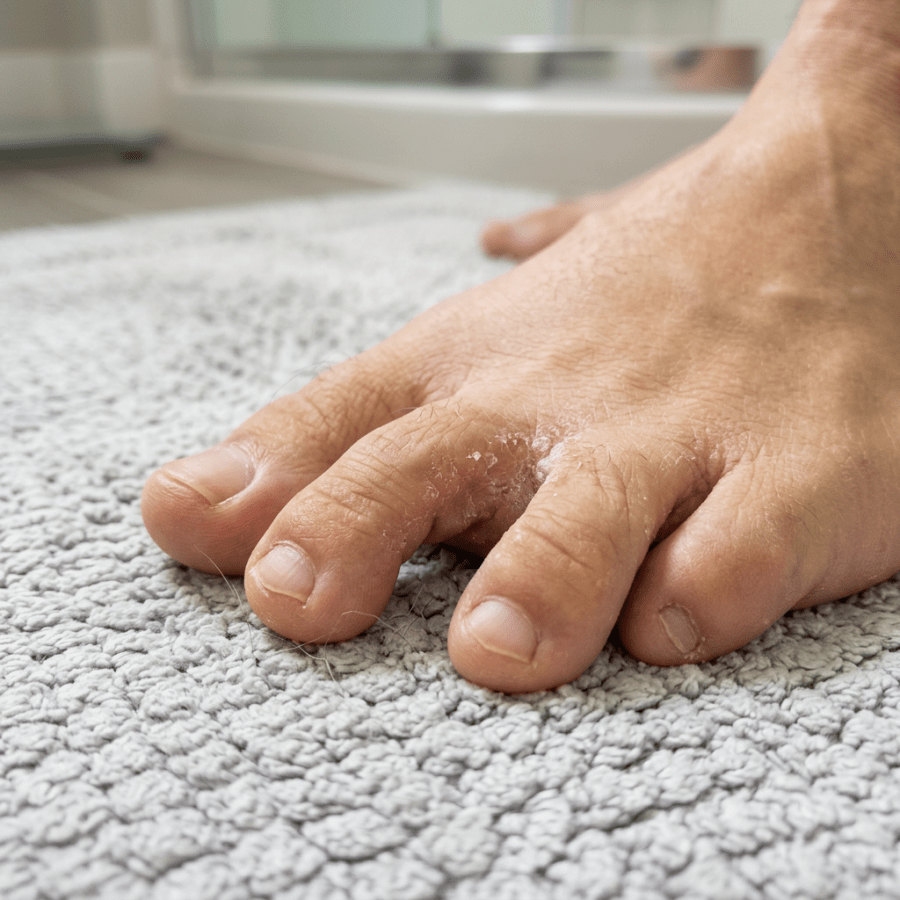
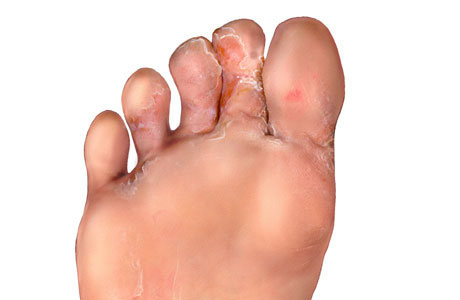
Tinea pedis (athlete’s foot): the skin of the feet (often between the toes of the 3-5th toes) become itchy, red, tender, cracked and scaly. We also see it on the soles of feet and in this area it is usually scaly and simply looks like dry skin. Sometimes blisters form on the feet, especially between the toes. It’s very important to treat athlete’s foot in diabetic patients because the fungal infection predisposes the patient even worse – a bacterial infection in the feet. Diabetic patients can have a decreased sensation on their feet, so they can develop worsening infections without realizing it. We usually start by removing the dead, scaling skin from the feet, and then treat athlete’s foot with a topical antifungal cream such as Lamisil AT twice a day for up to 12 weeks. The fungus can live on the skin even after the scaling skin is gone, so it’s important to treat the infection even for 1 week after the infection is totally gone. This infection can be very difficult to treat because if you miss a day of applying the cream, the fungal infection can grow rapidly. It’s important to keep the feet as dry as possible because fungal infections grow better in warm, damp areas.
Tinea corporis (body infection): often occurs when the fungal infection is transferred from one part of the body to another. It is commonly seen in high school wrestlers. It usually appears as a circular or oval scaly area with an outer red edge that is slightly raised while the center is usually flat and skin colored. We treat this infection with a topical antifungal medication twice a day for 1-2 weeks. Wrestlers may not be allowed to compete (by their school policy) until their infection clears.
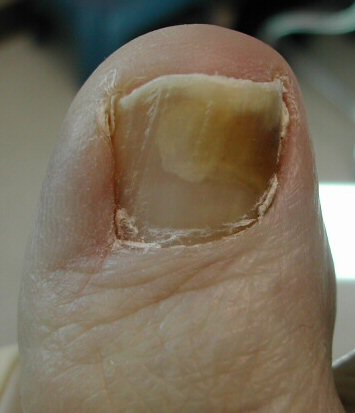
Onychomycosis (fungal nail infection): a fugal infection of the nail that causes the nail to thicken, and change color such as white, yellow or brown. This type of infection happens most commonly in the toenail but can also happen in fingernails. Fungal nail infections are common and don’t usually lead to serious long-term problems. It is usually very easy to diagnose a fungal infection of the nails just by examining them. Most over the counter medications don’t work for fungal nail infections. In fact even prescription medications don’t work very well, and most fungal nail infections return after being treated with oral antifungal medications. In addition, the oral medications used to treat fungal infections of the nails can cause severe liver disease, so I usually don’t recommend treating this type of infection and instead recommend keeping the nails trimmed to prevent nail fracture or trauma.
Preventing ringworm:
1) Do not share clothing or sports equipment/towels with others
2) Wear slippers or sandals at the gym, local pool or public shower
3) Wash with soap and shampoo after skin-to-skin contact with others
4) Avoid tight-fitting clothing to allow the skin to dry
5) With athlete’s foot, put socks on before underwear to prevent spread of the fungal infection to other parts of the body including the groin
6) Treat pet fungal infections to prevent spread to humans
7) If a family member has a fungal infection, make sure they get treatment right away
To find a Dermatologist in your area, the American Academy of Dermatology’s Website has a very useful locator: http://www.aad.org/find-a-derm
I hope that you have found this information useful. Wishing you the best of health,
Photo credit: http://fluconazole.biz/fluconazole-resistant-tinea/
People come to their doctor quite frequently due to fungal infections of the skin or nails. One might think that because of the name, “Ringworm,” it would be caused by a worm, but it is actually caused by a fungus. The shape of the rash looks like a ring and thus it got its name. It’s a red, itchy rash on the skin and is also caused tinea.
Four different type of ringworm infections are named for the body-part that is affected:
1) Tinea capitis affects the head or scalp and is mostly seen in children
2) Tinea pedis affects the feet and is called athlete’s food because athlete’s common acquire it in the locker room
3) Tinea cruris affects the groin and is also called jock itch because it also commonly affects athletes or “jocks” presumably because of the moisture on the skin that the fungus prefers
4) Tinea corporis is a term for fungal infections that affect other body surfaces
Ringworm is a contagious infection and can be spread by someone else who is infected or even by an infected dog or cat. It may be spread in a shower stall, locker room floor or pool area. Often small skin shavings from the infected person are left behind in these areas and an unknowing person touches the infected area with their feet or other body part.
Tinea capitis: a fungal infection of the scalp may be related to cradle cap in children. It causes a red scaly rash and can lead to bald patches. It rarely affects adults. We treat scalp infections with either oral or topical medications or a combination of both. Children often improve with the use of gentle massage of the scalp during a bath to remove the scaly areas and then use of an antifungal medical on the scalp to kill the bacteria. Adults and children are usually treated with oral medications and treatment can take 2-12 weeks depending on the severity of the infection.
Tinea pedis (athlete’s foot): the skin of the feet (often between the toes of the 3-5th toes) become itchy, red, tender, cracked and scaly. We also see it on the soles of feet and in this area it is usually scaly and simply looks like dry skin. Sometimes blisters form on the feet, especially between the toes. It’s very important to treat athlete’s foot in diabetic patients because the fungal infection predisposes the patient even worse – a bacterial infection in the feet. Diabetic patients can have a decreased sensation on their feet, so they can develop worsening infections without realizing it. We usually start by removing the dead, scaling skin from the feet, and then treat athlete’s foot with a topical antifungal cream such as Lamisil AT twice a day for up to 12 weeks. The fungus can live on the skin even after the scaling skin is gone, so it’s important to treat the infection even for 1 week after the infection is totally gone. This infection can be very difficult to treat because if you miss a day of applying the cream, the fungal infection can grow rapidly. It’s important to keep the feet as dry as possible because fungal infections grow better in warm, damp areas.
Tinea corporis (body infection): often occurs when the fungal infection is transferred from one part of the body to another. It is commonly seen in high school wrestlers. It usually appears as a circular or oval scaly area with an outer red edge that is slightly raised while the center is usually flat and skin colored. We treat this infection with a topical antifungal medication twice a day for 1-2 weeks. Wrestlers may not be allowed to compete (by their school policy) until their infection clears.
Onychomycosis (fungal nail infection): a fugal infection of the nail that causes the nail to thicken, and change color such as white, yellow or brown. This type of infection happens most commonly in the toenail but can also happen in fingernails. Fungal nail infections are common and don’t usually lead to serious long-term problems. It is usually very easy to diagnose a fungal infection of the nails just by examining them. Most over the counter medications don’t work for fungal nail infections. In fact even prescription medications don’t work very well, and most fungal nail infections return after being treated with oral antifungal medications. In addition, the oral medications used to treat fungal infections of the nails can cause severe liver disease, so I usually don’t recommend treating this type of infection and instead recommend keeping the nails trimmed to prevent nail fracture or trauma.
Preventing ringworm:
1) Do not share clothing or sports equipment/towels with others
2) Wear slippers or sandals at the gym, local pool or public shower
3) Wash with soap and shampoo after skin-to-skin contact with others
4) Avoid tight-fitting clothing to allow the skin to dry
5) With athlete’s foot, put socks on before underwear to prevent spread of the fungal infection to other parts of the body including the groin
6) Treat pet fungal infections to prevent spread to humans
7) If a family member has a fungal infection, make sure they get treatment right away
To find a Dermatologist in your area, the American Academy of Dermatology’s Website has a very useful locator: http://www.aad.org/find-a-derm
I hope that you have found this information useful. Wishing you the best of health,
Athlete’s foot and thickened fungal nails matter more than they look, because the cracks they leave between the toes are a common entry point for a deeper foot infection. That risk is highest in diabetes, which is why I wrote a separate post on how to check and protect your feet when you have diabetes.
Updated for 2026: There Is a Resistant Ringworm Now
When I wrote this in 2012, ringworm was a nuisance with a reliable answer. Put an antifungal cream on it, wait a couple of weeks, done. For most people that is still true. But a genuinely new problem has arrived and it is worth your knowing about, because it changes what to do when the cream does not work. Trichophyton indotineae emerged on the Indian subcontinent and has spread internationally, including to multiple US states. It is frequently resistant to terbinafine through mutations in the squalene epoxidase gene. One documented US case had a terbinafine minimum inhibitory concentration of 16 micrograms per milliliter, which is to say the drug was doing essentially nothing (1). It tends to look different. Extensive rather than a tidy ring. Often on the face, trunk, and groin at once. Sometimes a ring inside a ring. Intensely itchy, widespread, and stubborn in a way ordinary ringworm is not. It has also been reported as possibly sexually transmitted (2). The frustrating part is that an ordinary fungal culture cannot tell it apart from garden variety Trichophyton. Identifying it takes specialized gene sequencing available at only a handful of labs. Itraconazole usually works, but often needs more than three months. Terbinafine resistant Trichophyton rubrum, the far more common species, is also increasing in the United States (3).What That Means Practically
Mostly it means stop assuming that treatment failure is your fault for not applying the cream long enough. If you have had an adequate course of a topical antifungal, or a proper course of oral terbinafine, and the rash is still spreading, that is not a reason to run the same drug again. That is a reason to have the diagnosis reconsidered and, if it still looks fungal, to change class rather than repeat. For ordinary tinea nothing has changed much. Body and groin ringworm respond to a topical antifungal over about two weeks, and the terbinafine class tends to clear it slightly faster than the azoles. Athlete’s foot takes longer, roughly four weeks with an azole. For toenails, oral terbinafine 250 milligrams daily remains first line, and current guidance is to confirm the diagnosis with testing before committing someone to months of an oral antifungal (3).The Video Visit Version
Most of what I need for this one I can get from a photograph and a few questions, which makes it a reasonable fit for a virtual visit. What helps me is a well lit close up, plus a wider shot showing how far it extends. Tell me how long it has been there, what you have already tried and for how long, whether anyone else at home or any pet has it, and whether you have been treating it with a steroid cream, because a steroid on ringworm changes its appearance and makes it worse. Where I will send you elsewhere is toenails. If we are talking about months of an oral antifungal, I want the diagnosis confirmed rather than assumed, and roughly half of thickened toenails turn out not to be fungal at all.When To Be Seen In Person
Extensive or rapidly spreading tinea that has already failed proper treatment, which raises the question of the resistant species and needs specialized testing. Scalp involvement, which needs oral treatment and cannot be handled with cream. Pain, warmth, or spreading redness suggesting a bacterial infection on top, particularly if you are diabetic. And any widespread fungal infection if your immune system is suppressed.The Bottom Line
Ordinary ringworm is still ordinary and still responds to cream. What is new is that a failed course now means something. If two weeks of the right treatment has not touched it, do not just buy another tube. Get it looked at again.Sources
1. Caplan AS, et al. Notes from the Field: First Reported US Cases of Tinea Caused by Trichophyton indotineae. https://www.ncbi.nlm.nih.gov/pmc/articles/PMC10208369/ 2. Potential Sexual Transmission of Antifungal-Resistant Trichophyton indotineae. Emerging Infectious Diseases. 2024;30(4). https://wwwnc.cdc.gov/eid/article/30/4/24-0115_article 3. Diagnosis and Management of Tinea Infections. American Family Physician. October 2025. https://www.aafp.org/afp/2025/1000/tinea-infectionsRelated Reading
Scabies Infection: The Mite Bite When to Use Telemedicine vs. Urgent Care: How I Spot the Sick One Scott Rennie, D.O.Board Certified in Obesity Medicine and Family Medicine
This blog is for educational purposes only and does not constitute individual medical advice. Always consult your own physician before making changes to your health, medications, or treatment plan.
 Doctor Rennie's Blog
Pingback: Scabies Infection – The Mite Bite – Doctor Rennie's Blog
Pingback: Seborrheic Dermatitis – Dandruff, Cradle Cap and Adult Seborrhea – Doctor Rennie's Blog