
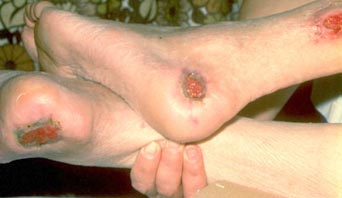
Photo credit: http://diseasespictures.com/bedsores/
A patient came in to see me today with a sore on his heel that’s been bothering him for the past few months. He’s diabetic and has lost feeling in the bottom of his feet. He’s had these pressure sores in the past but has trouble getting them to heal up.
Pressure sore: An area of skin damaged by pressure, such as sitting or lying in one position for a long period. They are also called bedsores. They are most common where bone sits near the surface of the skin: the hips, elbows, ankles, and back or buttocks. The skin and soft tissue become damaged because not enough oxygenated blood reaches the area to support healing, usually because the soft tissue is compressed between the surface and the hard bone beneath.
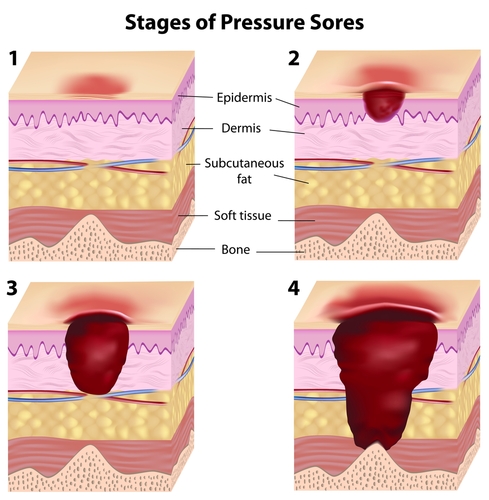
Appearance: The sores change in appearance depending on how long they have been present and how much damage has been done. At the start, the sore looks like a small red patch of skin. If it is not treated, the skin breaks down and a hole or crater forms, which is what we call an ulcer.
Stage 1: The skin is intact without ulceration, but when you press on it the color does not change the way it should. Healthy tissue is pink, and pressing on it with a finger blanches it, with the pinkness returning within a couple of seconds. That does not happen in damaged skin at this stage, and the area may look darkly pigmented.
Stage 2: There is an open, shallow ulcer with a red-pink base. Blisters may be present, either intact or ruptured.
Stage 3: Structures beneath the skin such as fat may be exposed, but at this stage you should not see bone, tendon or muscle.
Stage 4: Bone, tendon and muscle may be visible in the base of the ulcer.
People at risk: Some patients are far more likely than others to develop pressure sores.
- Patients who cannot move well because of a medical problem. They may sit or lie in one position for a long time and need help repositioning so the skin does not break down.
- Older people, who often move less and whose skin is thinner and more fragile.
- Patients with diabetes or nerve problems in their feet, who may not feel a pebble in a shoe or pressure building against the foot.
- Patients in the hospital or a nursing home, who are at especially high risk because several of these factors stack: increased age, reduced mobility, and other complicated medical problems.
Prevention: Several things lower the chance of developing pressure sores.
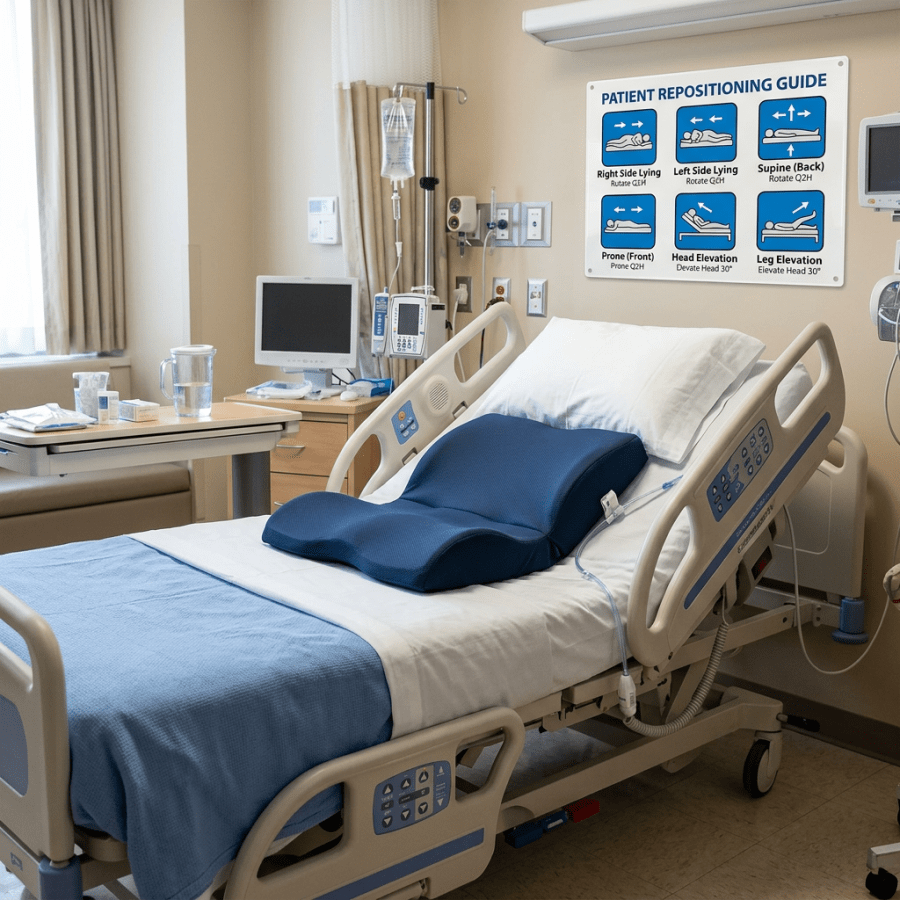
- Repositioning the patient’s body every two hours so no one area of skin stays crushed, pinched or under pressure.
- Putting pillows between the ankles and knees to reduce pressure on the skin over those bony areas.
- Raising the head of the bed when the patient is lying on their side to reduce pressure on the hip bone.
- Using special foam or soft mattresses that reduce pressure over the areas that bear the most load.
For patients in wheelchairs:
- Use a cushioned seat if possible to prevent pressure on the sacrum.
- Tilt forward or to the side every hour to release pressure on the seat.
- If the ankles or heels press against the chair, use foam padding to protect against sores.
- Check the skin regularly for signs of pressure or ulceration.
Treatment: Pressure sores are treated differently depending on the stage and how severe the skin damage is.
- If there is mild erythema, treatment is generally offloading the area by reducing the time it spends compressed, through repositioning and pillows to cushion it. We also use transparent films over the ulcers to protect them.
- In patients with diabetes, keeping blood sugars under good control is very important. Elevated blood sugars impede wound healing.
- If there is dead or dying skin or soft tissue, it often needs to be removed to help prevent infection.
- Special bandages may be needed to keep the healing tissue moist while preventing maceration from being too moist. The dressings we use can be expensive.
- Antibiotics may be prescribed if there is a wound infection.
- Medication for pain may also be prescribed.
There are scoring tools to grade pressure and track healing. These help for patients who return for repeat visits to a wound care clinic or their primary care provider and need their progress graded. Clinical features examined include:
- Amount of exudate
- Skin color surrounding the wound
- Peripheral tissue swelling
- Peripheral tissue firmness around the wound
- Amount of granulation (healing) tissue
- How much epithelialization is present
It’s important to optimize the nutritional status of patients with wounds. Patients with stage 3 and stage 4 ulcers in particular need enough protein and calories to heal.
Board Certified in Obesity Medicine and Family Medicine
This blog is for educational purposes only and does not constitute individual medical advice. Always consult your own physician before making changes to your health, medications, or treatment plan.
 Doctor Rennie's Blog