
 Photo credit: http://www.skindermatologists.com/p/scabies-lice.html
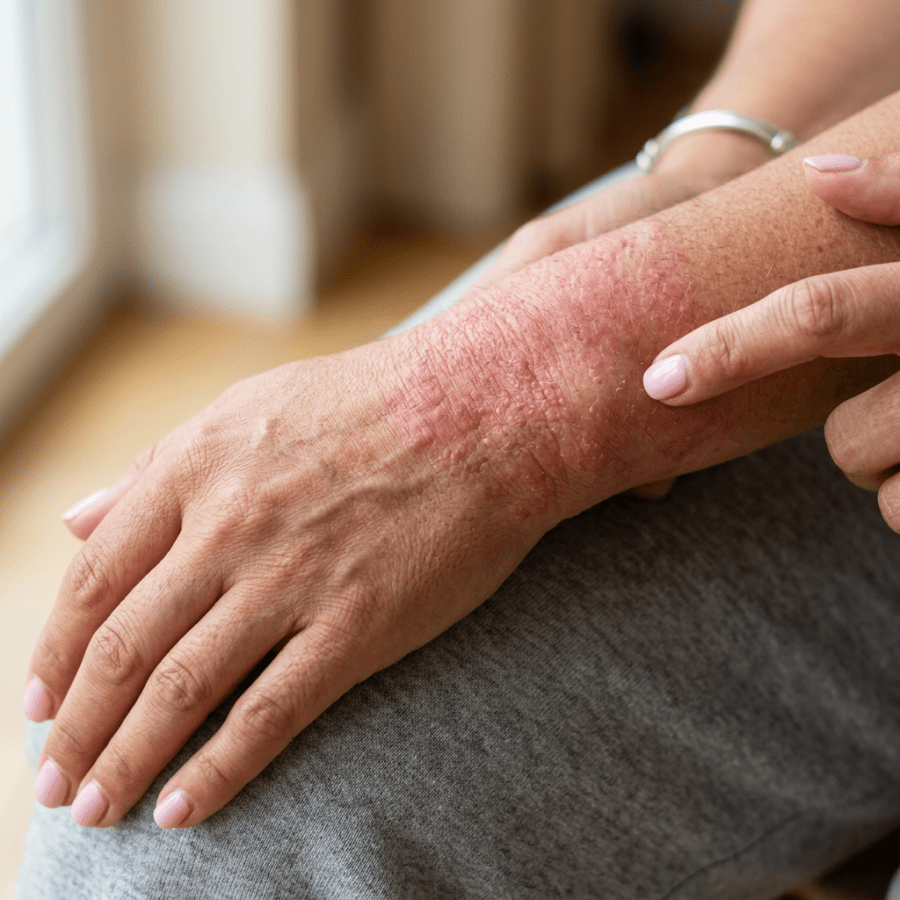
Every now and then a patient will come into the clinic with a scabies infection. They usually have complaints of severe itching and a reddish colored rash.
Scabies is caused by a very small mite called Sarcoptes scabiei. It is spread from one person to another by close skin-to-skin contact and I’m seeing more and more patients with scabies lately so I think it’s becoming more common.
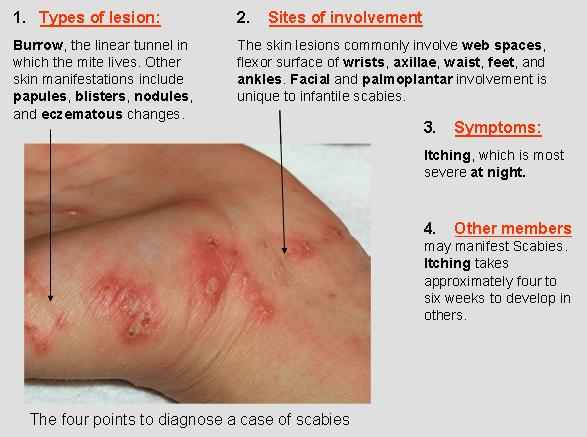
Symptoms: An itchy rash is the most common symptom, and it’s often worse at night. It causes visible lesions (red colored bumps or blisters) on the skin but sometimes these little bumps are tough to see. Certain parts of the body are most commonly affected by scabies including:
1) Between the fingers
2) Around the wrists (especially on the inside of the wrists)
3) In the crease of the elbows
4) Behind the knees
5) In the armpits
6) Around the nipples
7) Around the penis
8) Around the waistband
9) Near the low back and upper thighs
10) Along the sides and bottoms of the feet
The back and head are usually not affected.
Crusted scabies: Some people with weakened immune system can develop “crusted scabies” or “Norwegian scabies” which are described as large, crusty red patches or bumps on the skin that spread easily. The scalp, hands, and feet are affected most often. These lesions are usually not itchy but can contain many mites.
Scabies mite:
Photo credit: http://www.skindermatologists.com/p/scabies-lice.html
Every now and then a patient will come into the clinic with a scabies infection. They usually have complaints of severe itching and a reddish colored rash.
Scabies is caused by a very small mite called Sarcoptes scabiei. It is spread from one person to another by close skin-to-skin contact and I’m seeing more and more patients with scabies lately so I think it’s becoming more common.
Symptoms: An itchy rash is the most common symptom, and it’s often worse at night. It causes visible lesions (red colored bumps or blisters) on the skin but sometimes these little bumps are tough to see. Certain parts of the body are most commonly affected by scabies including:
1) Between the fingers
2) Around the wrists (especially on the inside of the wrists)
3) In the crease of the elbows
4) Behind the knees
5) In the armpits
6) Around the nipples
7) Around the penis
8) Around the waistband
9) Near the low back and upper thighs
10) Along the sides and bottoms of the feet
The back and head are usually not affected.
Crusted scabies: Some people with weakened immune system can develop “crusted scabies” or “Norwegian scabies” which are described as large, crusty red patches or bumps on the skin that spread easily. The scalp, hands, and feet are affected most often. These lesions are usually not itchy but can contain many mites.
Scabies mite:  It is caused by a tiny mite that has 8 legs and is whitish-brown in color. Without a magnifying glass, you might not be able to see them at all. The symptoms are caused by the female mites, which tunnel into the skin after being fertilized by the males. The female mite lays eggs under the skin and continues to tunnel until she dies, usually 1-2 months later. After the mites hatch, the young mites travel back to the skin surface, mate and repeat the cycle of tunneling and laying more eggs.
Transmission: Close skin-to skin-contact is the usual way that scabies is spread, but it can also be spread through the clothes of an infected patient. If someone who is uninfected wears a shirt or jacket of someone who is infected, the little mites can infect another patient. It takes about 3-4 weeks for signs or symptoms of a first scabies infection to develop after becoming infected with the mites. It’s also commonly transmitted between young adults during sexual contacts. Once the mites are no longer in contact with the skin, then can only live for 24-36 hours but they can survive longer in colder conditions. They are seen more commonly in the winter than in the summer months.
Treatment: Treatment of scabies can be challenging – see recommendations below. Most of the time we treat scabies with a topical skin cream called permethrin (also called Elimite). For patients with the more difficult to treat – crusted scabies, we use both a topical and oral anti-parasitic pill called ivermectin. The permethrin cream (5%) is preferred for young infants and pregnant mothers.
1) It is very important to apply the cream carefully to cover all the skin from the neck down to the feet.
2) Treat all family members if they are in close contact with the infected person even if the family members don’t have symptoms. The reason is to avoid repeating the cycle of infection.
3) Wash or isolate any clothing, bedding, towels, pajamas, underwear or stuffed animals that the patient has touched within the last three days before the treatment started. You can place the items in a plastic bag for three days to isolate them and the mites will die. You can also wash the clothing in hot water.
Itching can be treated with antihistamines such as Claritin or Zyrtec. Benadryl is helpful, but is sedating so we generally only recommend that at night. Itching may persist for several weeks even after the mites are eliminated. A steroid cream or a course of oral steroids may be recommended if itching is severe.
I hope that you have found this information useful. Wishing you the best of health,
It is caused by a tiny mite that has 8 legs and is whitish-brown in color. Without a magnifying glass, you might not be able to see them at all. The symptoms are caused by the female mites, which tunnel into the skin after being fertilized by the males. The female mite lays eggs under the skin and continues to tunnel until she dies, usually 1-2 months later. After the mites hatch, the young mites travel back to the skin surface, mate and repeat the cycle of tunneling and laying more eggs.
Transmission: Close skin-to skin-contact is the usual way that scabies is spread, but it can also be spread through the clothes of an infected patient. If someone who is uninfected wears a shirt or jacket of someone who is infected, the little mites can infect another patient. It takes about 3-4 weeks for signs or symptoms of a first scabies infection to develop after becoming infected with the mites. It’s also commonly transmitted between young adults during sexual contacts. Once the mites are no longer in contact with the skin, then can only live for 24-36 hours but they can survive longer in colder conditions. They are seen more commonly in the winter than in the summer months.
Treatment: Treatment of scabies can be challenging – see recommendations below. Most of the time we treat scabies with a topical skin cream called permethrin (also called Elimite). For patients with the more difficult to treat – crusted scabies, we use both a topical and oral anti-parasitic pill called ivermectin. The permethrin cream (5%) is preferred for young infants and pregnant mothers.
1) It is very important to apply the cream carefully to cover all the skin from the neck down to the feet.
2) Treat all family members if they are in close contact with the infected person even if the family members don’t have symptoms. The reason is to avoid repeating the cycle of infection.
3) Wash or isolate any clothing, bedding, towels, pajamas, underwear or stuffed animals that the patient has touched within the last three days before the treatment started. You can place the items in a plastic bag for three days to isolate them and the mites will die. You can also wash the clothing in hot water.
Itching can be treated with antihistamines such as Claritin or Zyrtec. Benadryl is helpful, but is sedating so we generally only recommend that at night. Itching may persist for several weeks even after the mites are eliminated. A steroid cream or a course of oral steroids may be recommended if itching is severe.
I hope that you have found this information useful. Wishing you the best of health,
I wrote this in 2012. Most of my work now is obesity medicine. I am board certified in it, and if that is what brought you to the site, I keep a current post on what Wegovy and Zepbound cost without insurance.
Updated for 2026: One Dose of Ivermectin Is Not Enough
This post has been read more than any other thing I have written, which is a strange fact about the internet, and it means the parts of it that have aged badly are worth correcting. The biggest one is dosing. Oral ivermectin at 200 micrograms per kilogram used to get handed out as a single dose. It should not be. Ivermectin does not kill the eggs, so a single dose leaves the next generation to hatch. A 2024 systematic review put the numbers on it: treatment failed in 15.2 percent of people given one dose against 7.1 percent given two (1). The second dose goes at day eight to fourteen. If you were treated once and are still itching two weeks later, that is the first thing I would ask about. Permethrin 5 percent is still first line and the technique still matters more than the prescription. Neck down in adults, jawline down, everything, including between fingers and toes and under the nails. Leave it on eight to fourteen hours. Repeat at day seven or eight. In infants it goes on the scalp and face too (2).There Is a New Drug, and an Old One That Should Be Gone
Spinosad 0.9 percent topical suspension, sold as Natroba, was approved for scabies in April 2021. It was the first genuinely new scabies drug in more than thirty years. Worth knowing about if permethrin has failed you. Lindane is the other direction. It has been pulled in the United States over neurotoxicity, and if you find it recommended on an old page somewhere, that page is out of date. Mine included, until now.About Resistance, Carefully
You will find a lot written about permethrin resistance. I want to be precise here, because the confident version circulating online runs ahead of the evidence. What the data actually show is that treatment failure has been creeping up, on the order of a quarter of a percent per year, and that reduced susceptibility has been observed in some communities, northern Australia in particular (1). What has not been established is a confirmed genetic resistance mechanism driving it. The authors of that review say so directly. Failure is rising. Why is not settled. Poor application technique and untreated household contacts explain a great deal of what gets called resistance.Why Scabies Suits a Video Visit
Of all the rashes I am asked to look at on a screen, this one plays to the strengths of the format rather than against them. Scabies is diagnosed mostly on story. Itching that is dramatically worse at night. Weeks, not days. Other people in the house scratching too. A distribution that favors finger webs, wrists, waistband, armpits, and, in men, the genitals. I can get all of that by talking to you, and a decent close-up photo of a finger web often gets me the rest. What I also get from a video visit that I would not get in a clinic room is the household. I can ask who else is itching and treat everyone at once, which is the single most common reason scabies comes back. Everyone in the home gets treated on the same day whether or not they itch. Bedding and clothing from the previous three days go through a hot wash and a hot dryer. Expect to keep itching for two to four weeks after successful treatment. That is the immune reaction settling, not failure, and it sends a lot of people back for unnecessary repeat courses.When This Needs To Be Seen In Person
Thick, crusted, scaly plaques rather than scattered bumps. That is crusted scabies, it carries an enormous mite burden, it is far more contagious, and it needs combination treatment and infection control rather than a tube of cream. It shows up most often in people who are elderly, immunosuppressed, or living in a care facility (2). Also: skin that has become infected from scratching, an infant with widespread involvement, or a second completed course that has not worked.The Bottom Line
Treat everyone in the house on the same day. Apply it properly. Repeat the dose, whichever drug you are on, because nothing available kills the eggs. And give the itch a month to settle before deciding the treatment failed.Sources
1. Mbuagbaw L, Sadeghirad B, Morgan RL, et al. Failure of scabies treatment: a systematic review and meta-analysis. British Journal of Dermatology. 2024;190(2):163-173. https://academic.oup.com/bjd/article/190/2/163/7251446 2. Iyengar L, Chong AH, Steer AC. Scabies: a clinical update. Medical Journal of Australia. 2024;221(10). https://www.mja.com.au/journal/2024/221/10/scabies-clinical-updateRelated Reading
When to Use Telemedicine vs. Urgent Care: How I Spot the Sick One Ringworm, Athlete’s Foot and Fungal Nail Infections Scott Rennie, D.O.Board Certified in Obesity Medicine and Family Medicine
This blog is for educational purposes only and does not constitute individual medical advice. Always consult your own physician before making changes to your health, medications, or treatment plan.
 Doctor Rennie's Blog