
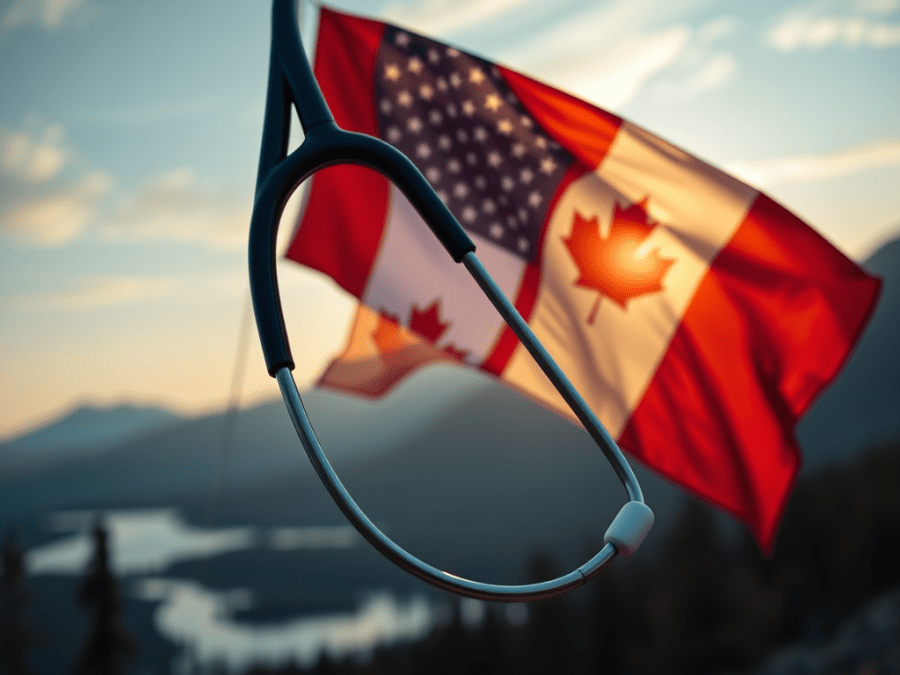
I have had several conversations recently with colleagues who are seriously considering leaving the U.S. to practice in Canada. This is not happening quietly. Interest from U.S.-trained physicians in moving north has jumped sharply over the past year, and the reasons run deeper than any single administration or policy.
American physicians looked at Canada as an option well before the current political moment. What changed is the volume. CanAm Physician Recruiting reported a 65 percent increase in inquiries between January and April, with some days bringing calls from as many as 15 U.S. doctors asking about moving immediately.
The licensing numbers tell the same story. According to the Medical Council of Canada, U.S. physicians creating accounts on physiciansapply.ca, typically the first step toward licensure, rose from 71 to 615 over seven months. That is a 765 percent increase. Ontario registered 116 U.S.-trained doctors in the first quarter of 2025, at least 50 percent more than the prior two quarters. British Columbia licensed 28 U.S.-trained physicians in the fiscal year ending February 2025, roughly triple the year before.
KFF Health News reported on one emergency physician, identified only as Michael, who moved his family to Canada this year. He described the work of a physician as “being kind to people who are in their weakest place,” and said he no longer saw that reflected in the country he was practicing in. KFF and NPR granted him anonymity because he feared reprisal if he returned to the U.S.
Canada’s publicly funded system is part of the draw. Physicians cite fewer administrative obstacles and more stability. Licensing rules have also loosened to help fill shortages, which lowers the barrier for U.S. doctors considerably.
Canada has its own problems, and they are not small. The country needs roughly 23,000 more family physicians to meet current demand. Surgical wait times and crowded emergency departments are real. For a lot of American physicians the trade is still worth making.
Universal coverage carries weight of its own. When every patient is covered, the work shifts back toward care and away from arguing about whether a medication or a scan will be approved. I think about my family in Isokyrö, Finland, where this is simply how it works. They do not worry about losing insurance when they change jobs. They do not put off care because of what it will cost. It is treated as a basic obligation of a society, and it feeds the trust people have in their physicians.
Recent shifts in U.S. health policy are pushing more doctors to look north. The American Academy of Family Physicians, American Academy of Pediatrics, and American College of Osteopathic Family Physicians have all criticized changes to federal vaccine guidance, including the removal of COVID-19 vaccine recommendations for healthy children and pregnant women, decisions made outside the CDC’s Advisory Committee on Immunization Practices, and appointments of individuals with a documented history of vaccine skepticism. These groups have filed suit and issued public statements about the erosion of evidence-based policy.
None of this is hypothetical. I know a family physician who left a chaotic Texas clinic for a small town in Ontario. She gave up income and proximity to family. What she got back was the ability to practice the way she was trained to, without political interference.
Leaving is hard. Licenses, families, and routines hold people where they are. But when physicians feel their core values are under threat, a move like this stops looking dramatic and starts looking reasonable. That is the part worth paying attention to. This is not really a trend. It is a symptom.
If you are curious about Canadian licensing or how this shift might affect your own career, I am glad to talk it through. We all went into medicine to take care of people, and a fair number of our colleagues are going where they believe they can still do it.
Scott Rennie, D.O.
Board Certified in Obesity Medicine and Family Medicine
This blog is for educational purposes only and does not constitute individual medical advice. Always consult your own physician before making changes to your health, medications, or treatment plan.
Sources:
- KFF Health News. American Doctors Are Moving to Canada To Escape the Trump Administration: https://kffhealthnews.org/news/article/american-doctors-moving-canada-escape-trump-administration-manitoba/
- NPR. American doctors look to relocate to Canada to avoid the Trump administration: https://www.npr.org/sections/shots-health-news/2025/05/29/nx-s1-5414345/american-doctors-look-to-relocate-to-canada-to-avoid-the-trump-administration
- American Academy of Pediatrics and others sue HHS over vaccine policy
- AAFP: Speak out to defend vaccine science and public health
- U.S. pediatric group breaks with federal policy on COVID vaccines
- Pediatricians issue independent vaccine recommendations
- AAFP letter expressing concern over dismissal of ACIP

 Doctor Rennie's Blog