
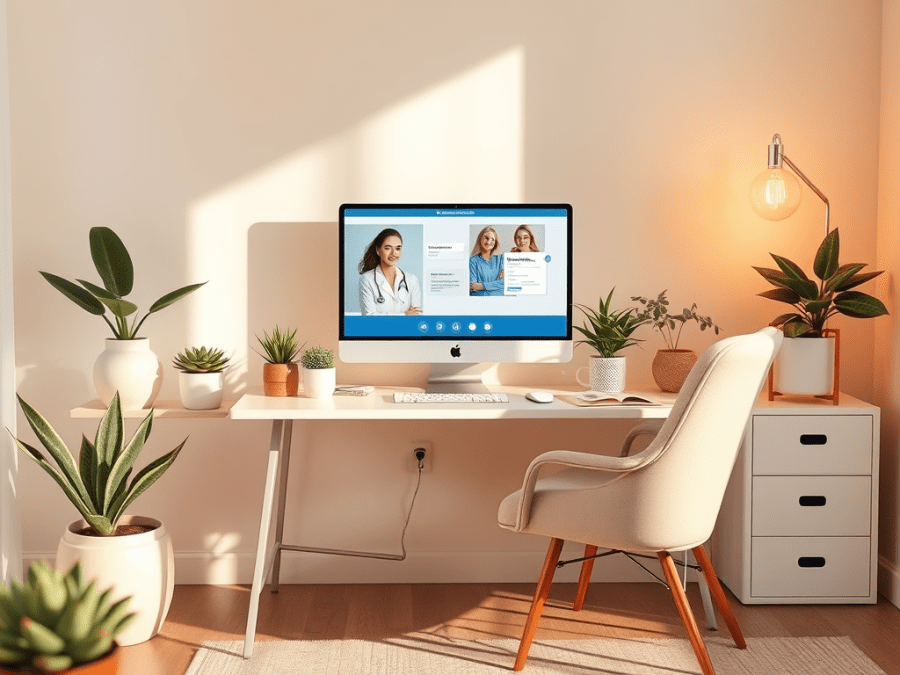
For many women, menopause care has long been an afterthought in traditional medicine. The conversation often starts late, if it happens at all. Now, thanks to telemedicine, that’s beginning to change.
Over the last few years, virtual menopause clinics have emerged to fill a long-standing gap in women’s health. Clinics like Midi Health and Menopause RX connect women directly with clinicians trained in menopause care. According to the Centers for Disease Control and Prevention, about 42 percent of women now use telemedicine, and a growing number are using it specifically for midlife and menopausal health (Pevzner, 2025; CDC, 2025).
This shift matters. Research shows that most doctors receive little or no formal training in menopause management. A 2019 Mayo Clinic report found that only 7 percent of medical residents felt prepared to manage menopause (Mayo Clinic Proceedings, 2019). Women often report their symptoms being dismissed or overlooked. In a 2025 survey of 1,000 women aged 45 to 60, nearly 71 percent said their physician didn’t adequately prepare them for menopause or discuss treatment options (Pevzner, 2025).
That’s where telemedicine can help. Virtual menopause clinics provide timely access to clinicians who understand hormonal transitions and can offer evidence-based guidance. As Dr. Sherry Ross, an ob-gyn in California, explained in a Yahoo Health interview, these platforms solve many of the problems in the current healthcare system, particularly access and education (Pevzner, 2025).
Telehealth also reaches women in rural or underserved areas where menopause-certified specialists are scarce. The Menopause Society, formerly NAMS, highlights this benefit in its educational resources, noting that virtual platforms can deliver specialized care to women who might otherwise go without it (The Menopause Society, 2025). On my own panel, roughly 25 percent of women arrive already on hormone therapy started elsewhere; most others are still looking to start when they get to me. That tells me how far this shift has already gone outside primary care.
Virtual visits handle a fairly wide range of these symptoms: hot flashes, sleep disturbance, mood changes, low libido, and mild vaginal dryness lead the list, and each of these can often be addressed through careful history, lifestyle interventions, and evidence-based hormonal or non-hormonal therapies (Pevzner, 2025).
Of course, telehealth isn’t the right fit for everyone. Complex or potentially serious symptoms such as postmenopausal bleeding, abnormal discharge, breast changes, or pelvic pain still require in-person evaluation. As Dr. Robin Noble, a gynecologist in Maine, reminds clinicians, some conditions simply can’t be ruled out without a physical exam (Pevzner, 2025).
That balance is important. Telemedicine can’t rule out postmenopausal bleeding, abnormal discharge, or a breast change over video, and it shouldn’t try to. The best virtual programs integrate follow-up visits, communicate with the patient’s primary physician, and make sure screenings like mammograms and Pap smears stay on schedule (The Menopause Society, 2025).
When colleagues ask how to steer patients toward credible virtual options, I start with licensure: is the provider licensed and, ideally, certified by The Menopause Society (MSCP)? From there, check that the clinic’s data security is HIPAA-compliant, and don’t sign on until there’s a real process for ongoing monitoring and coordination of care (The Menopause Society, 2025).
Here’s where I push back on the marketing a little. Platforms like to say virtual care “closes the gap,” but a same-day video visit doesn’t fix a residency curriculum that gave menopause a few hours of teaching total. It gets a patient to someone who knows the topic faster. It doesn’t fix why so few primary care doctors learned it in the first place.
Some version of this comes up constantly: a woman held off on raising her symptoms because she didn’t want to waste the doctor’s time. Then she gets to someone who takes the question seriously, and what she finds is reassurance and a plan. That’s the kind of access we should all want for our patients: timely, informed, and respectful of their experience.
Menopause care is finally catching up with the rest of modern medicine, and telemedicine is a big part of why.
References
Pevzner, H. (2025, July 30). Your complete guide to getting menopause help online. Yahoo Health. https://www.yahoo.com/lifestyle/menopause-telehealth-guide
Centers for Disease Control and Prevention (CDC). (2025). Telemedicine utilization data.
Mayo Clinic Proceedings. (2019). Menopause education in residency training.
The Menopause Society (formerly NAMS). (2025). Professional resources and video library.
Board Certified in Obesity Medicine and Family Medicine
This blog is for educational purposes only and does not constitute individual medical advice. Always consult your own physician before making changes to your health, medications, or treatment plan.
 Doctor Rennie's Blog