

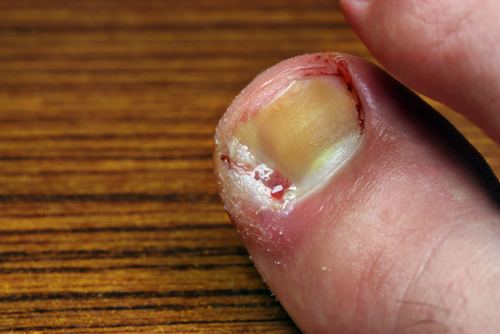
 I see patients who come into the clinic for ingrown nails, most often toenails but even ingrown fingernails can bring people to the doctor.
Paronychia: an inflammation involving the lateral and proximal fingernail folds. It can be acute (rapid onset) or chronic (long-standing).
Causes: occupations where the hands are in the water frequently, nail biting, thumb sucking, overzealous manicuring and even diabetes can lead to fingernail infections.
Ingrown toenail: The big toe is most commonly affected. Signs and symptoms can include pain, swelling, drainage and granulation tissue. It’s more common to get ingrown toenails from poor fitting shoes, toe trauma, excessive trimming of the lateral nail plate, or in patients who have a over-curvature of the nail which can be hereditary or acquired.
Acute nail infections are usually accompanied by redness, and pain at the sides of the nail, sometimes with a blister that can be filled with purulent material If the patient hasn’t been biting their nails, the infection is most often caused by Staphylococcus aureus or Steptococcus pyogenes or a combination of both. Different bacteria are often present if the patient is a nail biter.
Chronic nail infections are often associated with eczema, however it can also be complicated by a Candida or yeast infection of the nails.
Diagnosis: In the clinic we can usually tell that there is a nail infection by the appearance of the nail folds on examination. If a purulent fluid collection is present, the diagnosis is even easier to make.
Treatment: If the infection has come on rapidly (acute onset), the treatment usually involves warm compresses or soaks to the affected finger or toe for 20 minutes three times/day. Antibiotics that are taken orally may be helpful in severe causes. Topical antibiotics such as triple antibiotic ointment might be helpful after soaking the digit, but there isn’t a lot of research to support it.
If there is an abscess present, incision and drainage is usually helpful in addition to the above treatments. We usually perform a digital block to numb the finger or toe for comfort before the surgery is performed. Treatment with antibiotics is common and we usually use them for 5 days after a surgical drainage and for 7-10 days if there is no drainage. The choice of the antibiotic depend on whether the patient has been biting the nails, and the patient’s history of drug allergies. Possible treatment options include dicloxacillin, Keflex (no no MRSA in suspected) or Bactrim. We may also add metronidazole or clindamycin to the regimen if the patient has been biting their nails.
For ingrown toenails that are mild, we may place a cotton wedge or dental floss underneath the lateral nail plate to relieve the pressure and doing the soaks in warm soapy water for 10-20 minutes 3x/day. If the ingrown nail is severe however, we usually perform a partial nail removal after doing a digital block to relieve the discomfort. Antibiotics may be prescribed after partial nail removal may be helpful, however evidence has not shown that antibiotics decrease the healing time.
Follow-up after 3-4 days to assess treatment.
Recurrent ingrown toenails: May require treatment with permanent nail ablation surgery using both surgical excision plus phenol ablation (chemical matricectomy). The keeps the toenail from returning.
Post-op care after toenail removal: You should be able to put weight on both feet immediately after surgery, but walking will be uncomfortable. Some mild bruising and bleeding is normal after foot surgery. We usually apply some antibiotic ointment and 4×4” gauze, tube gauze and paper tape. After 24-48 hours, soak the affected toe in warm, soapy water and reapply antibiotic ointment and a clean bandage. This should be done 3-4x/day for 1-2 weeks after the procedure. Keep your foot and leg elevated while sitting or lying down and make sure your bandages are clean and dry at all times. We ask patients not to wear shoes for 3 days and recommend antibiotics and anti-inflammatory medications for 10 days.
I hope that you have found this information useful. Wishing you the best of health,
I see patients who come into the clinic for ingrown nails, most often toenails but even ingrown fingernails can bring people to the doctor.
Paronychia: an inflammation involving the lateral and proximal fingernail folds. It can be acute (rapid onset) or chronic (long-standing).
Causes: occupations where the hands are in the water frequently, nail biting, thumb sucking, overzealous manicuring and even diabetes can lead to fingernail infections.
Ingrown toenail: The big toe is most commonly affected. Signs and symptoms can include pain, swelling, drainage and granulation tissue. It’s more common to get ingrown toenails from poor fitting shoes, toe trauma, excessive trimming of the lateral nail plate, or in patients who have a over-curvature of the nail which can be hereditary or acquired.
Acute nail infections are usually accompanied by redness, and pain at the sides of the nail, sometimes with a blister that can be filled with purulent material If the patient hasn’t been biting their nails, the infection is most often caused by Staphylococcus aureus or Steptococcus pyogenes or a combination of both. Different bacteria are often present if the patient is a nail biter.
Chronic nail infections are often associated with eczema, however it can also be complicated by a Candida or yeast infection of the nails.
Diagnosis: In the clinic we can usually tell that there is a nail infection by the appearance of the nail folds on examination. If a purulent fluid collection is present, the diagnosis is even easier to make.
Treatment: If the infection has come on rapidly (acute onset), the treatment usually involves warm compresses or soaks to the affected finger or toe for 20 minutes three times/day. Antibiotics that are taken orally may be helpful in severe causes. Topical antibiotics such as triple antibiotic ointment might be helpful after soaking the digit, but there isn’t a lot of research to support it.
If there is an abscess present, incision and drainage is usually helpful in addition to the above treatments. We usually perform a digital block to numb the finger or toe for comfort before the surgery is performed. Treatment with antibiotics is common and we usually use them for 5 days after a surgical drainage and for 7-10 days if there is no drainage. The choice of the antibiotic depend on whether the patient has been biting the nails, and the patient’s history of drug allergies. Possible treatment options include dicloxacillin, Keflex (no no MRSA in suspected) or Bactrim. We may also add metronidazole or clindamycin to the regimen if the patient has been biting their nails.
For ingrown toenails that are mild, we may place a cotton wedge or dental floss underneath the lateral nail plate to relieve the pressure and doing the soaks in warm soapy water for 10-20 minutes 3x/day. If the ingrown nail is severe however, we usually perform a partial nail removal after doing a digital block to relieve the discomfort. Antibiotics may be prescribed after partial nail removal may be helpful, however evidence has not shown that antibiotics decrease the healing time.
Follow-up after 3-4 days to assess treatment.
Recurrent ingrown toenails: May require treatment with permanent nail ablation surgery using both surgical excision plus phenol ablation (chemical matricectomy). The keeps the toenail from returning.
Post-op care after toenail removal: You should be able to put weight on both feet immediately after surgery, but walking will be uncomfortable. Some mild bruising and bleeding is normal after foot surgery. We usually apply some antibiotic ointment and 4×4” gauze, tube gauze and paper tape. After 24-48 hours, soak the affected toe in warm, soapy water and reapply antibiotic ointment and a clean bandage. This should be done 3-4x/day for 1-2 weeks after the procedure. Keep your foot and leg elevated while sitting or lying down and make sure your bandages are clean and dry at all times. We ask patients not to wear shoes for 3 days and recommend antibiotics and anti-inflammatory medications for 10 days.
I hope that you have found this information useful. Wishing you the best of health,
For most people an ingrown toenail is a nuisance. With diabetes or neuropathy it is a different problem, because an infected nail edge on a foot you cannot feel well is how some ulcers start, which is why I wrote about protecting your feet if you have diabetes.
Updated for 2026: Mostly Confirmed, With One Number Worth Having
I went looking for what had changed here since 2012 and the honest answer is: not much. No major society has rewritten this in the last few years. The approach I described holds up. So rather than manufacture a revolution, here is what has been sharpened. For an ingrown toenail bad enough to need a procedure, the thing that matters is whether the nail matrix gets treated, not just the nail edge removed. Partial nail avulsion combined with chemical destruction of the matrix using phenol gets cure rates above 95 percent. Avulsion alone does not. A 2025 trial of 140 patients put recurrence at 1.43 percent with phenol against 10 percent without (1). So if you are offered a procedure for a recurring ingrown nail, the question worth asking out loud is whether the matrix is being treated. That single detail is the difference between fixing it and doing it again next year.Chronic Paronychia Is Not an Infection
This is the part I most want to correct, because it is treated wrongly all the time. Acute paronychia, the hot painful swelling beside a nail that comes on over a day or two, is an infection. Warm soaks, and if there is a pocket of pus it needs draining. Once it is drained, oral antibiotics usually are not necessary. They get reserved for spreading cellulitis, a suppressed immune system, or someone who is genuinely unwell (2). Chronic paronychia, meaning six weeks or longer, is a different animal. It is an irritant dermatitis, driven by repeated wet work and exposure, and treating it with antifungals or antibiotics does not work because it is not an infection. The treatment is getting the hands out of the water, barrier protection, and a topical steroid or calcineurin inhibitor. It takes weeks to months to settle, and people abandon treatment long before that (2). If you have had a swollen nail fold for two months and have been through three courses of antibiotics, that is the pattern.What This Looks Like Over Video
A photograph does most of the work here, and this is one where I want more than one angle. From directly above and from the side, so I can see whether the nail fold is simply inflamed or whether there is a pocket of pus lifting it. What I need from you beyond that is duration, which is the single most useful question, along with what your hands or feet are exposed to during the day, whether you are diabetic, and what has already been tried. I can settle the chronic cases from here, and those are the ones most often mismanaged. What I cannot do is drain anything or take a nail off, so if there is pus, or if the nail needs a procedure, my job becomes telling you that clearly and getting you to someone who can do it.When To Be Seen, Sometimes Urgently
Spreading redness, red streaking, or fever. Any toe infection at all if you have diabetes or poor circulation, where the threshold to be seen should be much lower than you think. Severe pain in the finger pulp, which can mean a felon. And pain on straightening the finger with a sausage shaped swelling, which suggests flexor tenosynovitis and is a same day surgical problem, not something to sleep on.The Bottom Line
For a nail that keeps growing in, ask whether the matrix is being treated. For a nail fold that has been swollen for months, stop taking antibiotics for it and start treating the skin.Sources
1. Comparison of Partial Nail Avulsion With or Without Phenolization in the Management of Ingrown Toenails. Cureus. May 2025. https://pmc.ncbi.nlm.nih.gov/articles/PMC12147675/ 2. Acute and Chronic Paronychia. American Family Physician. 2017;96(1):44-51. https://www.aafp.org/pubs/afp/issues/2017/0701/p44.html 3. Ingrown Toenail Management. American Family Physician. 2019;100(3):158-164. https://www.aafp.org/pubs/afp/issues/2019/0801/p158.htmlRelated Reading
Abscesses and MRSA: What To Do About a Skin Infection When to Use Telemedicine vs. Urgent Care: How I Spot the Sick One Scott Rennie, D.O.Board Certified in Obesity Medicine and Family Medicine
This blog is for educational purposes only and does not constitute individual medical advice. Always consult your own physician before making changes to your health, medications, or treatment plan.
 Doctor Rennie's Blog