
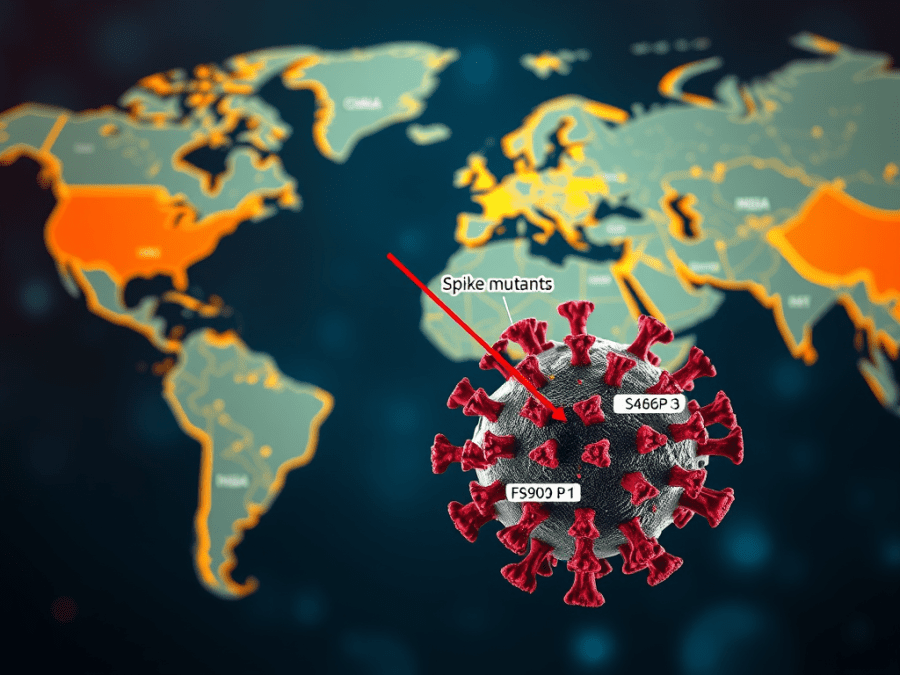
We all hoped COVID would fade into background noise by 2025. The virus did not agree. A new Omicron subvariant, NB.1.8.1, has been identified, and while it is not labeled a Variant of Concern, it is moving quickly enough in several countries to be worth paying attention to.
It was first identified in China earlier this year, then appeared in Australia, India, and the United States. Local outbreaks are being reported in dense areas including parts of California and New York. Genomic surveillance shows it spreading independently of travel patterns, which suggests it does not need help.
The subvariant carries several spike protein mutations: T22N, F59S, G184S, A435S, V445H, and T478I. These may improve binding to ACE2 receptors and blunt neutralizing antibodies. The pattern resembles BA.5, though NB.1.8.1 looks more efficient at evading immunity.
Laboratory data suggest moderate to significant immune escape. Antibodies from people who received current boosters show reduced neutralizing activity. The T-cell response, which is what keeps people out of the ICU, appears largely intact. That distinction is the reason boosters still matter, particularly for older adults and immunocompromised patients, and manufacturers are already adjusting formulations.
Early modeling puts NB.1.8.1 at 20 to 30 percent more transmissible than subvariants circulating in late 2024 such as JN.1, with possibly higher viral loads in the first two days. The practical translation is to test early and isolate immediately rather than waiting to see how it develops.
Symptoms are the ones we already know: sore throat, congestion, fatigue, dry cough, headache, fever. Some reports add hoarseness and mild GI upset such as nausea or abdominal discomfort, especially early on. That is not definitive yet, but on a video visit those two together are worth a second look, since I cannot examine a throat the way an in-person clinician can.
So far NB.1.8.1 has not been tied to more severe illness, and hospitalizations remain stable in vaccinated populations. The risk here is volume rather than severity. A variant that makes no one sicker can still overwhelm a health system if enough people get it at once, and places with fewer beds or lower booster uptake will feel it first.
What to do about it is not complicated. Prioritize updated boosters for high-risk groups. Consider masking indoors in long-term care settings when cases climb. Improve ventilation where you can. Test early, isolate early. Wastewater monitoring and sequencing give useful warning. Staffing, protective equipment, and telehealth capacity should all be ready to scale.
This is not 2020 again. It is the ordinary business of a virus that keeps evolving, and the response is the same as it has been: stay current, give patients clear guidance, and adjust when the data does.
Board Certified in Obesity Medicine and Family Medicine
This blog is for educational purposes only and does not constitute individual medical advice. Always consult your own physician before making changes to your health, medications, or treatment plan.
 Doctor Rennie's Blog