
 One of the most common questions that patients ask me is why they should take medication for cholesterol. They often don’t have any symptoms of high cholesterol and many people don’t like the idea of taking a medication for something that they don’t feel is causing them any problems. I felt like it was important to write a little bit about cholesterol, triglycerides, goals and treatment options.
So why should you care if your cholesterol is high? Did you know that there are both good and bad forms of cholesterol? What’s the difference between high cholesterol and hyperlipidemia? These are all great questions and I will attempt to answer them in this article.
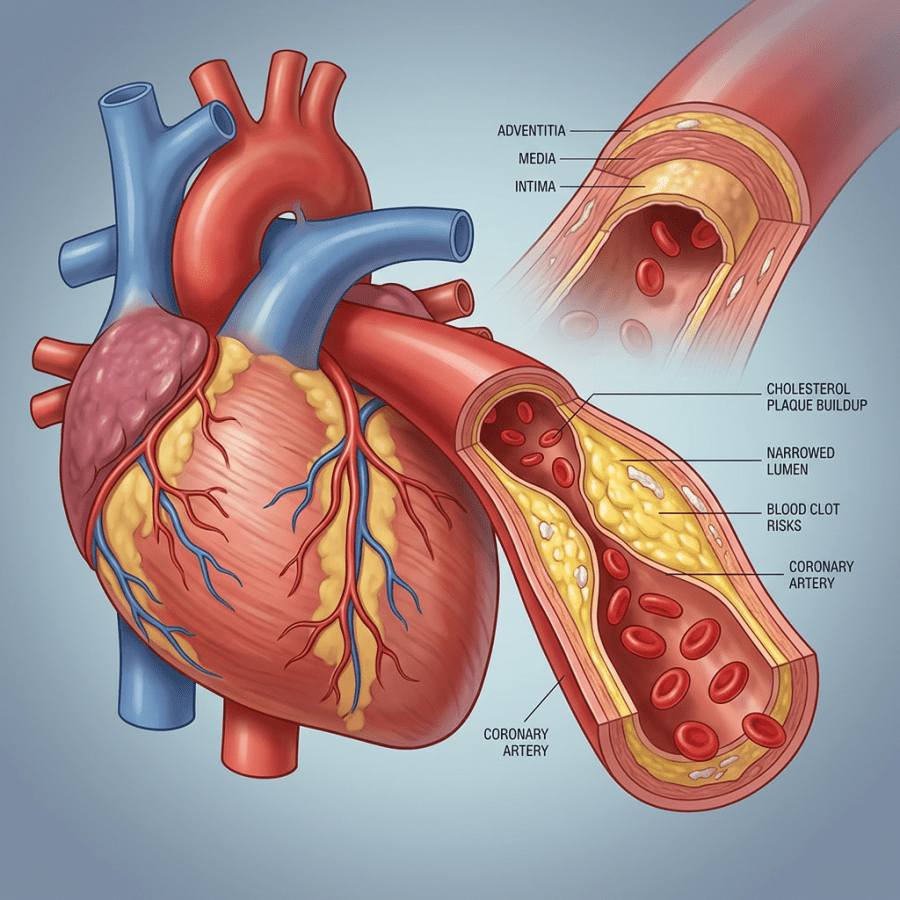
When we use the term hyperlipidemia, we are generally speaking about the amount of fats in the bloodstream being elevated. Fats include both cholesterol and triglycerides. When the level of fat is elevated in the bloodstream it can collect in your blood vessels and cause blockages.
If you think about your blood vessels as being hoses that feed the different organs of your body, you can imagine cholesterol as a substance which collects or coats the inside of these vessels so that the blood has a narrowed space to flow through. If too much cholesterol fills up in the blood vessels it can make it difficult for the blood to flow through this area and reach certain areas of the body.
If the blood flowing through your body is blocked and cannot get to a certain area of your heart, you could have a heart attack. If blood has trouble reaching an area of your brain, you could have stroke. So how do you know if your blood vessels are being blocked by fats such as cholesterol or triglycerides?
Will you have symptoms? It can be very challenging to know if you are getting fat from cholesterol and triglycerides stuck in your blood vessels. You might not have symptoms until the blood vessels become plugged to such a degree that blood cannot get through. At this time, your heart or brain may suffer permanent damage from a heart attack or stroke. It’s very important to prevent the blood vessels in the body from becoming plugged with cholesterol or triglycerides that we refer to a plaque when it combines with other cells of the body such as platelets.
Why are doctors even more worried about my cholesterol levels now that I was diagnosed with diabetes? Diabetes means that your blood sugars are likely higher than they should be. High sugar within the blood vessels causes damage that makes the inside of the vessels (where the blood flows) become sticky and the cholesterol and platelets stick inside the blood vessels that have been damaged by high blood sugar much easier. Smoking also causes damage (increased stickiness) to the insides of the blood vessels and makes it easier for cholesterol plaque to stick inside the arteries and potentially lead to a heart attack or stroke.
Most of us have heard the terms “good cholesterol and bad cholesterol.” Two difference forms of cholesterol known and LDL (Low density Lipoprotein) and HDL (High Density Lipoprotein) are commonly measured in your lipid tests. We like to see a high level of HDL because this type of cholesterol actually lowers the risk of heart disease and stroke by destroying the plaques that build up within the blood vessels. We like to see low levels of LDL because this type of cholesterol is the bad kind that combines with platelets and sticks inside the blood vessels and can increase the risk for heart attack or stroke. Total cholesterol is a combined measure of both the HDL and LDL cholesterol. You don’t need to fast anymore to be able to measure your cholesterol. There is a direct LDL and HDL test that can be done at your office visit without fasting (only if the local lab offers it). When I’m looking at the patients lab results, I’m more concerned about the HDL and LDL than I am with the total cholesterol because I want the HDL to be high and the LDL to be low.
So what should your cholesterol numbers be? Well that depends on your risk factors for heart attack, stroke, kidney disease and whether you have diabetes. We try to get the levels of LDL cholesterol lower in patients who have diabetes, kidney disease or who have already had a heart attack or stroke.
So how low should you go?
One of the most common questions that patients ask me is why they should take medication for cholesterol. They often don’t have any symptoms of high cholesterol and many people don’t like the idea of taking a medication for something that they don’t feel is causing them any problems. I felt like it was important to write a little bit about cholesterol, triglycerides, goals and treatment options.
So why should you care if your cholesterol is high? Did you know that there are both good and bad forms of cholesterol? What’s the difference between high cholesterol and hyperlipidemia? These are all great questions and I will attempt to answer them in this article.
When we use the term hyperlipidemia, we are generally speaking about the amount of fats in the bloodstream being elevated. Fats include both cholesterol and triglycerides. When the level of fat is elevated in the bloodstream it can collect in your blood vessels and cause blockages.
If you think about your blood vessels as being hoses that feed the different organs of your body, you can imagine cholesterol as a substance which collects or coats the inside of these vessels so that the blood has a narrowed space to flow through. If too much cholesterol fills up in the blood vessels it can make it difficult for the blood to flow through this area and reach certain areas of the body.
If the blood flowing through your body is blocked and cannot get to a certain area of your heart, you could have a heart attack. If blood has trouble reaching an area of your brain, you could have stroke. So how do you know if your blood vessels are being blocked by fats such as cholesterol or triglycerides?
Will you have symptoms? It can be very challenging to know if you are getting fat from cholesterol and triglycerides stuck in your blood vessels. You might not have symptoms until the blood vessels become plugged to such a degree that blood cannot get through. At this time, your heart or brain may suffer permanent damage from a heart attack or stroke. It’s very important to prevent the blood vessels in the body from becoming plugged with cholesterol or triglycerides that we refer to a plaque when it combines with other cells of the body such as platelets.
Why are doctors even more worried about my cholesterol levels now that I was diagnosed with diabetes? Diabetes means that your blood sugars are likely higher than they should be. High sugar within the blood vessels causes damage that makes the inside of the vessels (where the blood flows) become sticky and the cholesterol and platelets stick inside the blood vessels that have been damaged by high blood sugar much easier. Smoking also causes damage (increased stickiness) to the insides of the blood vessels and makes it easier for cholesterol plaque to stick inside the arteries and potentially lead to a heart attack or stroke.
Most of us have heard the terms “good cholesterol and bad cholesterol.” Two difference forms of cholesterol known and LDL (Low density Lipoprotein) and HDL (High Density Lipoprotein) are commonly measured in your lipid tests. We like to see a high level of HDL because this type of cholesterol actually lowers the risk of heart disease and stroke by destroying the plaques that build up within the blood vessels. We like to see low levels of LDL because this type of cholesterol is the bad kind that combines with platelets and sticks inside the blood vessels and can increase the risk for heart attack or stroke. Total cholesterol is a combined measure of both the HDL and LDL cholesterol. You don’t need to fast anymore to be able to measure your cholesterol. There is a direct LDL and HDL test that can be done at your office visit without fasting (only if the local lab offers it). When I’m looking at the patients lab results, I’m more concerned about the HDL and LDL than I am with the total cholesterol because I want the HDL to be high and the LDL to be low.
So what should your cholesterol numbers be? Well that depends on your risk factors for heart attack, stroke, kidney disease and whether you have diabetes. We try to get the levels of LDL cholesterol lower in patients who have diabetes, kidney disease or who have already had a heart attack or stroke.
So how low should you go?
- For someone who has had a heart attack or stroke: an LDL below 70-80 mg/dL is recommended, especially if they have diabetes or smoke
- If you have heart disease but do not smoke, have kidney disease or diabetes then we try to get the LDL below 100mg/dL
- If you do not have heart disease but have risk factors such as diabetes or tobacco use then we try to get the LDL below 130mg/dL
- If you have zero or only one risk factor for heart disease then we he try to get the LDL lower than 160 mg/dL
- High blood pressure
- Smoking
- Diabetes
- Kidney problems
- Family history of heart disease in a close relative under age 50
- Family history of high cholesterol
- As I already mentioned lifestyle modification including healthy dietary changes and increased exercise can be beneficial
- Niacin – see above
- Fish oil – Eating a diet rich in oily fish such as anchovies or tuna has been shown to help reduce triglyceride levels in some people. There are various companies that make fish oil supplements and most studies have recommended a daily 1 gram fish oil supplement to be tried if you do not eat enough fish.
Updated for 2026: The Risk Calculator Itself Was Replaced This Year
This post is from 2013, which turned out to be the exact year the ground started moving. Cholesterol guidance has been rewritten more than once since, and in March 2026 it changed again in a way that will affect whether some people are advised to take a statin at all. Start with what happened right after I wrote this. The old approach chased numbers. You had an LDL target, and treatment was titrated until you hit it. The 2013 guideline threw that out, because nobody had ever run the trial that tested treating to a target. What replaced it was risk based: estimate a person’s ten year cardiovascular risk, then pick a statin intensity to match (1). That is why your doctor may have stopped talking about your LDL number and started talking about your risk percentage. It confused a lot of people, including a fair number of physicians.What Changed in March 2026
The cardiology societies issued a new guideline on March 13, 2026, and the headline is that the risk calculator has been swapped out (2). The old Pooled Cohort Equations, in use since 2013, have been replaced by the PREVENT calculator. Two things about it are worth your attention. It no longer uses race as an input. The old equations adjusted risk by race in a way that was never biologically sound, and removing it is overdue. It also recalibrates risk downward. The older equations were overestimating ten year risk substantially. In practice that means some people previously told they should be on a statin will now calculate as lower risk than they did before. I want to be careful about how I put the next part. The 2026 guideline also revisits numeric LDL goals, which is a partial return to the target based thinking that was abandoned in 2013. I am not going to publish specific thresholds here, because I have not read them in the primary document rather than a summary of it, and a cholesterol number is not something to be approximately right about. Ask your own physician what target, if any, applies to you under the current guideline.Statin Intensity, Which Is the Part That Actually Matters
When someone says they are on a statin, the dose tells you more than the name does. High intensity means atorvastatin 40 to 80 milligrams or rosuvastatin 20 to 40 milligrams. Moderate intensity means atorvastatin 10 to 20, rosuvastatin 5 to 10, or simvastatin 20 to 40 (3). Plenty of people who believe they are treated are on a dose well below what their risk calls for. That is worth knowing about yourself. For prevention in people who have not had a cardiovascular event, the US Preventive Services Task Force position from August 2022 still stands: statins are recommended for adults aged 40 to 75 with at least one risk factor and a ten year risk of ten percent or more, and can reasonably be offered between 7.5 and ten percent. Above 75, they found the evidence insufficient to make a call either way (4).There Are Options Beyond Statins Now
In 2013 this was essentially a statin conversation, with ezetimibe as the one add on. That is no longer true. PCSK9 inhibitors, bempedoic acid, and inclisiran have all arrived since. None of them displaces statins as first line, and the last of those in particular is still accumulating hard outcome data. But if you genuinely cannot tolerate statins, or you are on a maximum dose and still not where you need to be, there are real options now, and there were not. Lipoprotein(a) is the other addition. It is largely inherited, it is not something diet or exercise moves, and it is not on a standard lipid panel. It has moved toward being measured once in a lifetime rather than not at all. If heart disease runs early in your family and nobody can explain why, it is worth asking about.Why This Suits a Video Visit Well
This is one of the things telemedicine handles about as well as anything. The lab draw happens near you, wherever is convenient. Everything after that is a conversation. Interpreting the panel, running your risk, deciding whether to treat, choosing an intensity, sorting out side effects, adjusting a dose. None of it requires me to be in the room. One practical note: for a baseline panel you generally do not need to fast anymore. Fasting still matters if your triglycerides run very high or there is a suspected inherited lipid disorder, so ask before you skip breakfast unnecessarily, or before you assume you can. What I cannot do from here is the blood draw, the liver or muscle enzyme checks if you develop symptoms, or a coronary calcium scan when your risk sits in the grey zone and we need a tiebreaker.Get Seen Urgently If
Chest pain, pressure, jaw or arm pain, sudden breathlessness, or stroke symptoms. That is an emergency, not a lipid appointment. Severe muscle pain or weakness on a statin, particularly with dark urine, which needs same day evaluation rather than stopping the drug and waiting. Triglycerides in the very high range, which carries a real risk of pancreatitis. An LDL of 190 or above, especially with a family history of early heart disease, which raises the question of familial hypercholesterolemia and is a genetics conversation rather than a routine one.The Bottom Line
If your risk was last calculated before 2026, it was calculated with equations that have since been replaced, and the answer may be different now. Find out what statin intensity you are actually on rather than just the name. And if you were told years ago that statins were your only option, that has not been true for some time.Sources
1. ACC/AHA Release Updated Guideline on the Treatment of Blood Cholesterol to Reduce ASCVD Risk. American Family Physician. August 15, 2014. https://www.aafp.org/pubs/afp/issues/2014/0815/p260.html 2. American College of Cardiology. ACC and AHA Issue Updated Guideline for Managing Lipids and Cholesterol. March 13, 2026. https://www.acc.org/about-acc/press-releases/2026/03/13/18/01/accaha-issue-updated-guideline-for-managing-lipids-cholesterol 3. Overview of the New ACC/AHA Lipid Guidelines. American Family Physician. June 1, 2019. https://www.aafp.org/pubs/afp/issues/2019/0601/p716.html 4. US Preventive Services Task Force. Statin Use for the Primary Prevention of Cardiovascular Disease in Adults. August 23, 2022. https://www.uspreventiveservicestaskforce.org/uspstf/recommendation/statin-use-in-adults-preventive-medicationRelated Reading
When to Use Telemedicine vs. Urgent Care: How I Spot the Sick One Scott Rennie, D.O.Board Certified in Obesity Medicine and Family Medicine
This blog is for educational purposes only and does not constitute individual medical advice. Always consult your own physician before making changes to your health, medications, or treatment plan.
 Doctor Rennie's Blog